

Preparing B2B eCommerce for the GEO Era

In 2026, visibility for B2B manufacturers is increasingly shifting from rankings to references. Not because SEO stopped working, but because shortlists are forming earlier, often before buyers ever hit your category pages or submit an RFQ.
For manufacturers with eCommerce, the GEO risk is rarely “AI can’t find us.” The more damaging risk: AI finds you and describes you wrong. When that happens, you lose RFQs you should win and attract RFQs you shouldn’t take.
You already know the basics of content and catalog hygiene. This post is about the business impact of AI-driven discovery and what “being ready” actually means at the decision-maker level.
AI Discovery Is Now a Pre-RFQ Gatekeeper
AI agents now select products, apply rules, and complete purchases inside a single flow, replacing the traditional cart and funnel with automated execution.
B2B discovery used to be linear: search, site visit, product evaluation, then RFQ. AI answer surfaces compress that path. A buyer can now ask one question and receive a shortlist with reasoning attached, often without opening multiple tabs. In practice, that looks like procurement and engineers pasting requirements into an answer engine and using the response as the first-pass filter before they ever engage suppliers.
That shift matters because the AI layer acts as a pre-RFQ filter. It’s not only helping buyers find options; it’s shaping which suppliers feel “safe” to contact.
In many categories, buyers aren’t trying to learn everything. They’re trying to eliminate risk: wrong fit, wrong compliance, wrong availability, slow replacement parts, weak documentation.
If your site isn’t easy to interpret, AI will still produce an answer. It just may anchor on easier sources, or summarize you in a way that doesn’t match your actual capability. Either outcome changes whether your sales team ever sees that RFQ.
How GEO Determines Which RFQs You Win
GEO, or Generative Engine Optimization, focuses on optimizing your content and product data for AI-driven discovery engines. It’s about ensuring that your website is accurately interpreted by AI to maximize visibility and improve how your business is referenced during the buyer’s journey.
The goal isn’t “more traffic” or even “more mentions.” The goal is more RFQs from buyers who already match your fit, with fewer missing details and fewer clarification cycles.
AI-driven discovery is pushing buyers toward constraint-heavy questions earlier in their process:
- “Supplier for food-grade EPDM gaskets that meet FDA and ship within 48 hours”
- “Alternative to Parker push-to-connect fittings compatible with 3/8 OD tubing”
- “Industrial VFD supplier with UL listing, documentation, and fast replacement parts”
Those aren’t top-of-funnel queries. They’re shortlist queries. If you show up clearly in those moments, you win better RFQs, not just more sessions.
Better AI visibility without better interpretability tends to produce the opposite: higher RFQ volume with missing feasibility details, more clarification back-and-forth, more quoting effort that doesn’t convert, and more risk of misquoted jobs.
For decision-makers, the right frame is revenue quality:
- Higher share of RFQs that match your capability
- Shorter time-to-quote because fewer basics are missing
- Fewer late-stage “this won’t work” moments
- Stronger conversion from RFQ to PO because buyer expectations were set correctly
The win isn’t traffic. The win is fewer bad conversations and more right-fit conversations, at scale.
The Biggest GEO Risk for Manufacturers: Misclassification
For manufacturers, misclassification is a big problem. AI can misread you in ways that directly impact both RFQ volume and RFQ quality:
- Overstating or understating compliance coverage
- Blurring stocked items versus build-to-order configurations
- Treating optional features as standard, or standard features as unavailable
- Summarizing compatibility in a way that sounds right but fails in practice
- Assuming your lead time is typical for the category when you’re actually faster (or slower)
Misclassification happens most often when key facts are fragmented across PDFs, line cards, inconsistent attributes, and tribal knowledge living in sales email threads. A human can reconcile contradictions. A summarizer can’t. It chooses the most extractable version of the truth, not the most accurate one.
This is why the GEO conversation for manufacturers is less about visibility and more about control: control over how your capability, constraints, and commercial reality are represented before the RFQ arrives.

If you missed the deeper breakdown of how misclassification happens and how it affects shortlisting, our team hosted a live session covering the full framework for B2B manufacturers.
Why Product Pages Alone Don’t Win RFQ-Intent Queries
Most B2B eCommerce sites have product pages. That’s not the problem.
The problem is that product pages rarely communicate the full decision context that drives shortlisting. Buyers evaluating suppliers are weighing more than a SKU:
- Fit for the application
- Limits and exclusions
- Documentation and compliance proof
- Availability and replacement speed
- Compatibility and interchange logic
- Whether the supplier can support the request without surprises
When that context is missing or scattered, AI answer surfaces can’t confidently justify recommending you. They default to sources that are easier to interpret, even if those sources aren’t the best suppliers.
The uncomfortable truth: in AI-driven discovery, being “technically correct somewhere on the site” isn’t enough. You need to be easy to quote correctly in the exact areas buyers use to rule suppliers in or out.
Interpretability Decides Who Gets Cited
When competitors are recommended over you, it’s often not because they have better products. It’s because they’re easier to interpret without guessing.
In many manufacturing categories, distributors and aggregators benefit here. They publish simplified selection guidance, cross-references, and plain-language compatibility notes that are easy to cite. Meanwhile, the manufacturer’s site can contain deeper truth, but in formats harder to extract or compare.
The outcome is strategic: the layer that gets cited becomes the layer that shapes the shortlist narrative. If a competitor or distributor is easier to quote than you, they can own the recommendation moment even when you’re the actual best fit.
What makes one source easier to cite than another? That’s the gap this post is pointing at. The mechanics, and what to do about them, go deeper than a single article can cover responsibly.
The Executive Lens: Two Questions Every Manufacturer Should Be Asking
You don’t need to become an AI lab to manage GEO. But you do need a leadership lens that matches how discovery is changing.
Two executive-level questions matter most:
1. Are we showing up in the RFQ intents that matter most?
Not every query is valuable. The highest-value queries are the ones buyers ask when deciding: fit, compliance, compatibility, replacement feasibility, and lead time viability.
2. When we show up, are we being described accurately?
If your sales team keeps correcting the same misunderstandings, that’s not just a sales problem. It’s a discovery-layer problem. Misinterpretation upstream becomes friction downstream.
This is also where governance matters. Manufacturing orgs often have multiple truth sources: ERP/PIM fields, PDFs, legacy spec sheets, and sales knowledge.
Conflicting data across ERP, PDFs, and sales knowledge isn’t new. What’s new is that AI will surface the conflict publicly, often by choosing the wrong version. Getting ahead of this means aligning on a single source of truth before AI chooses for you.
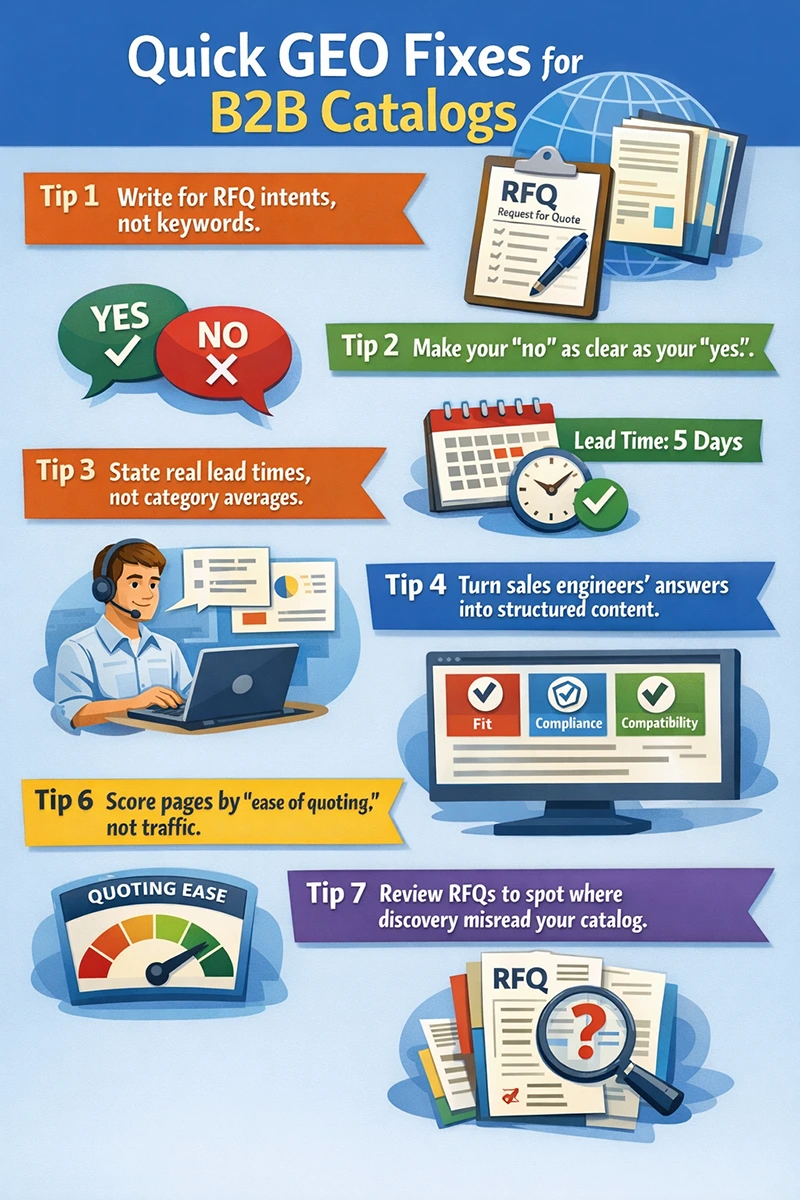
You’ve already framed the leadership questions, and before you move into the final “what to do next,” you drop in a simple, visual set of GEO tips.
Next Step: If You Think Your Catalog Is Being Misread
If you suspect AI answer surfaces are describing your products, compliance scope, compatibility, or availability in ways that don’t match reality, treat it as a commercial risk, not a marketing curiosity.
Misinterpretation changes which RFQs you receive, how qualified they are, and how often you’re shortlisted before a buyer ever contacts you.
Ready to fix your GEO gaps? Get started with simple, actionable steps.
Watch the webinar to learn how to fix your GEO gaps and improve RFQ fit while reducing misclassification.


