

Building Tomorrow’s Manufacturing Workforce: AI, Robotics & the Skills That Matter Now (Growth Files Ep. 2)

A robot just took over a welding job at a plant in Ohio. The welder who ran that line for 11 years is still employed, but no one has trained him on what to do next. The robot is running. The line is moving. And the worker is standing there, wondering where he fits.
This is the quiet crisis inside American manufacturing right now. It’s not about robots replacing people. It’s about manufacturers moving faster on the technology side than on the people side, and the gap is widening every quarter.
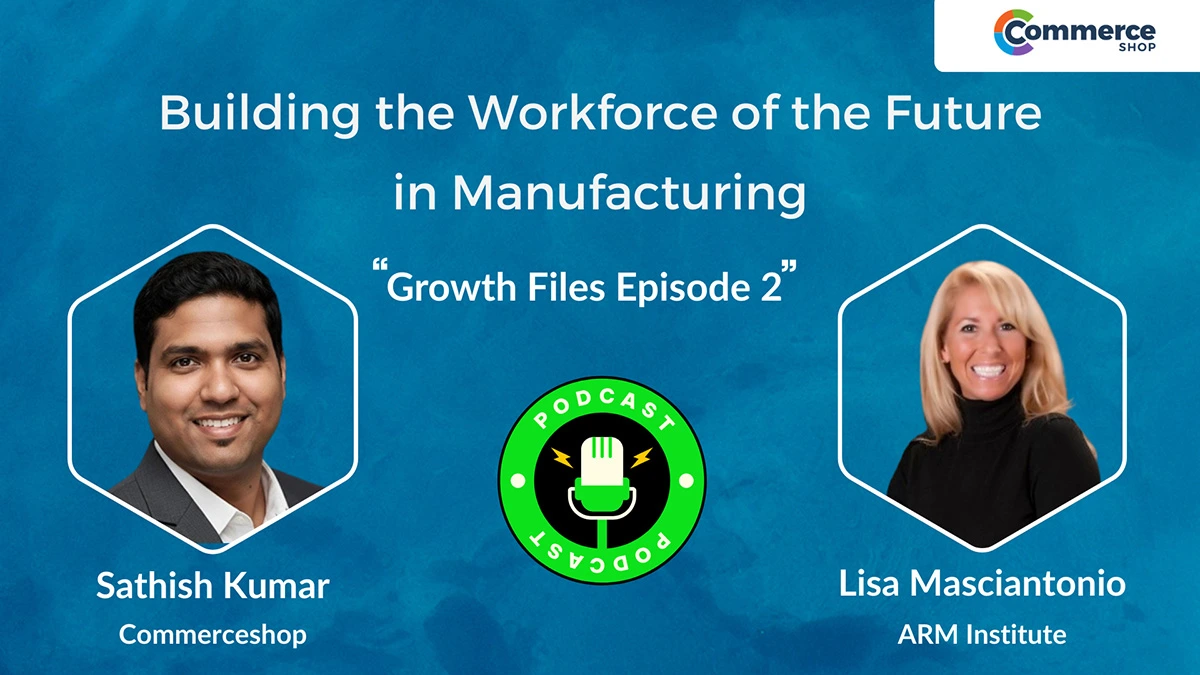
In Episode 2 of Growth Files, we sit down with Lisa Massie Antonio, Chief Workforce Officer at the Advanced Robotics for Manufacturing (ARM) Institute, one of 18 national institutes focused on revitalizing manufacturing in the United States. ARM’s charter sits at the intersection of robotics, automation, and AI, and Lisa has spent years mapping the exact skills that are missing, why training initiatives fail, and what manufacturers need to do differently right now.
Here’s everything that matters from that conversation.

Lisa Massieantonio Lisa Massieantonio is Chief Workforce Officer at the ARM Institute, a DoD-sponsored Manufacturing USA organization in Pittsburgh focused on robotics and AI. She leads workforce programs, training endorsements, and talent assessments across 17,000 training programs and 10,000 job postings.

Sathish Kumar is CEO of CommerceShop, an eCommerce consultancy focused on revenue-first optimization for brands scaling from $2M–$25M. He specializes in AEO, conversion optimization, and helping manufacturers adapt to AI-driven buyer journeys across complex B2B commerce ecosystems globally.
Episode TL;DR
- Future-ready workers need a balance of technical skills (e.g., troubleshooting AI-enabled robots, digital fluency) and soft skills (e.g., adaptability, problem-solving).
- Traditional roles like machine operators are evolving into robotic technicians; new jobs include integration planners and AI data specialists.
- The skills gap has three distinct layers: awareness, training access, and employer alignment. All three need solving at the same time
- ARM’s endorsement framework is the clearest way to evaluate whether a training program is worth the investment
- There are already between 500,000 and 1 million open manufacturing jobs right now. The talent shortage is the real threat, not humanoid robots
The Shift: Why Robotics and AI Are Reshaping Manufacturing Workforces
When people hear “future-ready manufacturing workforce,” they usually assume it means turning every floor operator into a software engineer. Lisa pushes back on that framing immediately.
Sathish: When you say you’re working on building a future-ready manufacturing workforce, is it more about technical training, or is it more about human skills?
Lisa: “I would argue that it’s the balance between the technology changes and adapting the technical capacity for what manufacturing workers have done in the past and where they’re going. We want to make sure that our education systems and the skills being obtained are keeping pace with those technological changes.”
Two things have to move together.
- First is digital and automation fluency: understanding how to work alongside robots, what changes when AI-enabled robotics enters the picture, what sensors do, and what the role looks like when the machine handles what humans used to.
- Second is the essential soft skills: to adapt, troubleshoot under pressure, ask the right questions, and keep learning when the tools around you keep changing.
Future-ready isn’t a credential. It’s a posture.
Manufacturing Roles That Will Change First (And Fastest)
Traditional operations are the first to feel automation. The jobs built around manual repetition do not disappear. They evolve. The question is whether workers are repositioned before or after the transition happens.
Lisa gives a concrete example:
Lisa: “Let’s say hypothetically I was a welder. A robot is helping to fulfill the needs. You now need somebody who makes sure that the robot is doing what it should do, how do you inspect the seams and so forth.”
System-Level Thinking and Integration Planning
The machine operator becomes a robotic technician or robot operator. The job now requires knowing how to maintain the system, troubleshoot problems, and have basic programming skills. The hands-on knowledge of the process is still essential, but it has to be paired with the ability to oversee, verify, and correct what the automation is doing.
Beyond that, two broader shifts are happening. As robots get smarter, the need for system-level thinking grows. Someone has to own strategic implementation: integration planning, application design, and how the automation connects to the rest of the environment.
AI-Enabled Robotics and Data Fluency
Then AI-enabled robotics adds another layer entirely: data collection, verification, labeling, ethical considerations, model testing, and calibration. Skills that did not exist on most plant floors five years ago.
When did the skills gap start costing more than the automation solving it?
AEO and GEO are already shaping how B2B buyers discover manufacturers. This conversation breaks down practical AEO and GEO tactics for B2B manufacturing.
Robotics Ops, Integration Planning, AI Readiness: The Three Jobs Manufacturing Needs Now
ARM has built two formal competency frameworks, one for robotics and one for AI, and made them publicly available at roboticscareer.org. Three job categories are emerging faster than most manufacturers are hiring for them.
- Robotics Operations covers running, monitoring, and troubleshooting robotic systems on the floor. This is where most transitioning workers can land with the right upskilling. Mechanical intuition plus digital competency.
- Integration Planning means designing how automation connects across an entire manufacturing environment. A hybrid role requiring both business logic and engineering reality to make end-to-end systems actually work.
- AI and Data Readiness means ensuring AI-enabled systems are fed accurate, verified, labeled data. Includes model testing, calibration oversight, and ethical judgment around how AI is used in production.
Most manufacturers don’t have formal job titles for any of these yet. That’s part of the problem.
As Lisa found when ARM first started mapping the space, job seekers and employers were missing each other on career platforms because they weren’t using the same language to describe what was needed.

▶ Listen to the full episode on Spotify to hear how manufacturers are building the workforce that makes automation actually work.
Where the Skills Mismatch Happens (Awareness, Training, Employer Alignment)
Sathish: What is the mismatch you see? Is it awareness, access to training, or employers not being ready to adapt?
Lisa: “Of those challenges, correct, correct, and correct. We see all of those challenges, and those actually are the pillars for the ARM Institute’s education and workforce development program.”
Most conversations about the skills gap treat it as one problem with one solution. It’s actually three distinct problems that each need their own intervention.
- Awareness is improving but incomplete.
Workers and students are hearing more about robotics and automation. But hearing about it and understanding what these new jobs actually look like, and how existing skills translate into new roles, are completely different things. The fear of robots taking jobs is still louder than the reality of the career paths being created.
- Training access and quality have a major resource gap.
When Lisa joined ARM, there was no single resource to help workers understand what training existed in their area or which programs were worth anything. roboticscareer.org now has 17,000 training programs mapped to specific robotics competencies. Progress, but programs are uneven, and keeping them current as technology evolves is a constant challenge.
- Employer alignment is where the most value is being quietly destroyed.
In 2017, ARM found that employers and job seekers were not calling jobs the same thing. On major career platforms, they were literally missing each other. Some of the largest manufacturers had 12,000 open roles they could not fill. For a small or medium manufacturer, even 12 unfilled technician positions slow throughput in ways that compound quickly.
Most In-Demand Skills in Automated Manufacturing
Sathish: If everything moves to robotics-enabled manufacturing, what is the most in-demand skill? Troubleshooting? Safety? Data? Integration?
Lisa: “I would categorize it as, there isn’t one skill cluster. It’s fit for purpose depending on what the manufacturing environment looks like.”
The shortage of CNC machinists, electricians, and skilled tradespeople has been chronic for decades. Automation adds new requirements on top of existing ones. The future-ready worker brings mechanical knowledge and adds digital fluency: troubleshooting systems, diagnosing sensor and software issues, and strong critical thinking.
The jobs exist. The gap is on the supply side.
What “Day 1” Looks Like for a Robotics-Ready Worker
Sathish: If somebody is trained for robotics manufacturing, what does their day one look like?
Lisa: “They’re probably not going to have great mastery on day one just because the environments are all so different. But I would say the most important thing is: make sure that you are ready to contribute on day one.”
What that baseline looks like in practice:
Basic robot and automation safety skills — Before anything else. Understanding physical risks, protocols, and the standards that govern how humans and robots work together.
Foundational troubleshooting — Being able to recognize whether a problem is mechanical, electrical, software, or sensor-related. Not necessarily solving every issue, but knowing which direction to go and who to involve.
Knowing how to ask for the right on-the-job training — This sounds soft but Lisa puts real weight on it. The people who ramp fastest are the ones who understand their knowledge gaps and actively seek mentoring to close them. Self-awareness is a technical advantage.
The employer has to meet that worker halfway with structured onboarding, visible career pathways, and learning embedded into daily operations.
How ARM Decides If a Training Program Is Worth Endorsing
Sathish: How does ARM evaluate training programs?
Lisa: “We have a formal method, and it’s called an ARM Endorsement. It’s not a certification program. It’s really looking at: is this program getting people ready to move into the appropriate industries?”
The ARM Endorsement is essentially an audit methodology applied to training programs. It evaluates five things:
Relevance: Is the curriculum aligned with what the industry actually needs right now, not in theory?
Effectiveness: Is the training efficient at getting people job-ready and teaching the right things in the right sequence?
Impact: Are people completing the program and getting jobs? Are they advancing over time?
Sustainability: Is the program financially viable, attracting enough participants, and building real employer relationships?
Transportability. Can someone enter from a high school CTE program and succeed, then move directly into a job or the next level of education?
The ARM Endorsement exists because the community asked for it. Manufacturers wanted to know which programs were worth recommending to their workers. Training providers wanted a way to signal quality. This framework answers both sides.
The Real Reason Workforce Training Fails Inside Manufacturing Plants
Sathish: What are the common reasons training initiatives fail inside plants?
Lisa: “The biggest problem that we see is bringing a training program that doesn’t really align with the real tasks that the individuals are focused on inside the working environment.”
Three failure modes come up consistently:
- Misalignment with actual work: Generic training that does not map to the specific machines, processes, or problems workers face on that floor. If it does not connect to their real job, engagement collapses, and the investment is wasted.
- No visible career pathway: Workers go through training without understanding what it is preparing them for. The training has to come with context: here is what you are learning, here is why it matters, here is where it takes you.
- Treating it as a one-time event: Continuous learning has to become part of daily operations, not a periodic disruption. Workers need to see learning as embedded in the job, not separate from it.
Smart Manufacturers Should Decide What to Automate (Dirty/Dull/Dangerous + Precision)
Sathish: When a manufacturer is introducing robotics, what’s the right thought process — replace people or train people?
Lisa: “I hate to think that any manufacturer just goes in and says, ‘Hey, what jobs can we automate?’ without having a serious understanding of why certain jobs should be automated.”
ARM uses a consistent framework for helping manufacturers make automation decisions. Three categories of work almost always make sense to automate first:
| Category | When to Automate | Why It Works |
|---|---|---|
| Dirty, Dull, and Dangerous | Jobs where people are getting hurt, turnover is high, or conditions are physically punishing | Improves safety, reduces turnover, frees workers for higher-value tasks |
| Speed Requirements | Where human throughput cannot match production needs | Meets volume requirements that human labor could not economically fulfill |
| High Precision | Where human variation creates quality or safety problems | Removes dangerous variability in tasks like exact dosage or inspection-critical output |
What the framework does not support is automating jobs simply because it is technically possible. That leads to purchasing equipment that does not solve a real business problem. Lisa has seen it happen many times.
Workforce Readiness Assessments During Automation Rollouts
This is one of the most practically important points in the conversation, and the one most manufacturers get backwards.
Lisa: “When you’re making the automation decisions — if you don’t focus on the worker in parallel, that can be detrimental.”
ARM runs what they call talent supply chain assessments. The logic is straightforward but rarely followed: before you cut over to a new automated line, you need to know whether your people will be ready to operate it the day it goes live.
That assessment asks:
Are the workers being trained in parallel with the installation? Is the right training available locally? Are retirements coming that will create gaps exactly when the new line goes live? Is there a pipeline of people who can be upskilled in time?
The failure mode is common. A manufacturer invests heavily in automation, cuts over, and discovers the workforce is not ready. The technology is in place. The people are not. The line underperforms. The ROI projections do not hold. And the thing that was always missing, parallel investment in the people, never gets addressed.
Digital Twins and VR Are Changing How Workers Train Before They Ever Touch a Machine
Sathish: Is there anything that lets manufacturers simulate what the new shop floor would look like before making the investment?
Lisa: “When you use something like a digital twin, and you’re able to simulate what kind of changes would happen to the line, some of those tools also can help to speed up the training.”
ARM’s robotics manufacturing hub in Pittsburgh helps manufacturers model automation decisions before committing capital: bottom-line impact, implementation timelines, safety requirements, and cost estimates.
On the training side, VR simulations let workers make mistakes in a low-risk environment, running through troubleshooting scenarios and building confidence before standing next to live equipment.
Lisa draws one clear line: “It can’t be completely replacing the hands-on experiences, at least from a workforce standpoint.” VR prepares. It does not substitute. The best programs use both.
Certifications in Robotics Manufacturing: What Actually Gets You Hired
Sathish: Is there any globally recognized certification that signals someone is ready for robotics manufacturing?
Lisa: “There are so many certifications and regulatory activities out there. And again, it’s the fit for purpose.”
A manufacturer might require OSHA certifications just to walk the floor. Another might prioritize specific degrees. A third might find a two-week boot camp gets someone job-ready. Some roles require a PhD.
Before investing in any certification, start with the job. What does this role actually require? What does this employer value? What is the fastest credible path to being productive? That determines which certification is worth pursuing. roboticscareer.org maps 17,000 training programs to specific competency frameworks because the right answer varies by role, sector, and employer.
CEO Lens: Workforce as a Strategic Advantage
Sathish: If I’m a CEO, what ROI can I expect in 12 to 36 months?
Lisa: “As a CEO, stay ahead of the talent curve. Use your workforce like a strategic capability, not as an HR problem, not just a training line item, but a core element of your competitiveness.”
Manufacturers who frame workforce development as a cost center are making a strategic error. The distinction shows up in how well automation transitions go, how fast lines recover after a cut-over, and how quickly organizations adapt when the technology changes again.
Lisa: “The technology is going to keep accelerating. Your demographics are going to be shifting. Act now to make sure that your workforce tomorrow and the next decade is ready for those changes.”
The risk is demographic as much as operational. Workforces are aging. Retirements are accelerating. Every year a manufacturer delays workforce investment is a year closer to a skills cliff that cannot be closed quickly.
Regulation, Ethics, and Governance: The Risks Leadership Is Underestimating
Sathish: Do you see negatives to robotics manufacturing that need guardrails?
Lisa: “In any fast-changing environment like this, you’re going to have regulations and opinions from policymakers. What we hope to do is give them unbiased information to help make those decisions in a meaningful and sensible way.”
Regulations are coming. The question is whether they are informed by reality or shaped by fear. Data collection and labeling, AI model oversight, and decision-making transparency in automated systems are governance questions manufacturers are already facing at the plant level, well ahead of any formal framework.
Humanoid Robots in Manufacturing: Separating the Hype from What’s Actually Happening
Sathish: With Optimus and humanoid robots being launched, will those come to manufacturing floors anytime soon?
Lisa: “We’ve not been brought into any of those discussions and I haven’t seen it on the shop floor. But with the pace and the innovation and the need, there is a huge need for more workers. So if we can’t get people into the trades, we’ll probably see more of that.”
There are currently between 500,000 and 1 million open manufacturing jobs in the United States right now. That number could reach 2.5 million within five years. In that environment, humanoid robots are not a displacement threat. They are a potential response to a shortage the training pipeline that cannot close fast enough.
Why Young Talent Is Not Choosing Manufacturing and What Changes That
Sathish: How should organizations make manufacturing more attractive for new graduates?
Lisa: “There are old myths. People think robots are taking jobs, and we don’t have enough people to fill the jobs. Those perceptions are sometimes moving people away from these great and exciting careers.”
Three myths are doing persistent damage:
- Robots are stealing jobs: The data shows a massive and growing labor shortage. This narrative is objectively wrong but dominates family conversations around career choices.
- Manufacturing is a dead end: Plant closure imagery from the 80s and 90s still shapes how parents talk to their kids. Higher wages, stronger job security, and meaningful technical work tell a completely different story today.
- It is not exciting work: Robotics, AI, precision engineering, and digital systems across every shift. Changing perception means showing what the work looks like now, not a generation ago.
Cobot Safety, Physical Risk, and the Cyber Threat: Most Shop Floors Are Not Ready For
Sathish: Are there specific safety skills people need for working with robotics?
Lisa: “The wonderful part is that the robots are becoming safer as well. They’ve got sensors, and they’ll slow down or stop before a human gets injured from working alongside them.”
Cobots are designed to work in shared spaces without cages. But awareness and protective behavior still matter. OSHA requirements and A3 safety standards exist for a reason, regardless of how capable the equipment becomes.
Then there is the layer most shop floors are not prepared for:
Lisa: “Introducing more automation invites some bad actors to also focus. Whether it be malicious or non-malicious intent, having this level of automation does provide cyber challenges. It’s the physical and the cyber awareness and putting in good practices that will keep the environment safe.”
As production lines connect to enterprise software and remote monitoring expands across facilities, the attack surface grows. A workforce trained only on physical safety is half-prepared. Cyber hygiene is becoming required knowledge on the shop floor.
What Manufacturers Must Do Now
The transformation is not a future event. It is happening now. Manufacturers who treat workforce readiness as a parallel investment alongside automation spend will be more competitive. Those who defer it will find the gap harder and more expensive to close.
1. Run a talent supply chain assessment before your next automation investment. Map who will operate the new system, identify training gaps, and know who is retiring before go-live.
2. Audit your local training landscape. Identify what programs exist in your area, what competencies they cover, and whether they match the roles you are hiring for.
3. Apply the dirty, dull, dangerous, and precision framework before automating. Start where automation creates clear safety, productivity, or quality benefits. Do not automate just because you can.
4. Build learning into daily operations, not one-time onboarding. Connect every training investment to a visible career outcome.
5. Treat the workforce as a strategic capability. Not an HR line item. A core element of your competitive position.
Ready to Future-Proof Your Manufacturing Workforce?
At CommerceShop, we help manufacturers close that gap with tailored digital commerce and AI strategies:
- Aligning workforce upskilling with your automation roadmap
- Integrating AI-powered tools for training, readiness assessments, and operational efficiency
- Building B2B eCommerce experiences that support digital transformation and talent enablement
Keep the Conversation Going
This is Episode 2 of Growth Files by CommerceShop, inside stories and strategies from manufacturing and B2B leaders navigating the shift to AI, robotics, and the workforce they require.
Also Watch ← Episode 1: AEO & GEO in B2B Manufacturing
Subscribe to Growth Files
Get insights from experts on how B2B buyers actually discover, evaluate, and decide in an AI-first world.


