

Fashion Wholesale eCommerce Platform Comparison: What B2B Buyers Actually Need in 2026
Most wholesale orders don’t fail at checkout. They fail before the order even starts.
A retail buyer logs in expecting to place a seasonal order quickly. Instead, they struggle to find the right variants, confirm pricing, or rebuild past orders. When that friction shows up, they don’t push through it. They switch to email, call a rep, or abandon the order entirely.
That disconnect is why so many fashion manufacturers and distributors end up replatforming. Not because their system is broken, but because it was never built for how wholesale buyers actually order.
As digital B2B continues to scale and buyers expect faster, self-serve experiences, platforms that cannot support real ordering workflows quietly lose revenue.
This comparison breaks down Shopify Plus, BigCommerce B2B Edition, and Adobe Commerce based on one thing that matters most: how well they support real wholesale buying behavior.
TL;DR: Quick Comparison
| Capability | Shopify Plus | BigCommerce B2B Edition | Adobe Commerce |
| Native B2B Buyer Portal | Yes | Yes, stronger natively | Yes, most configurable |
| Customer-Specific Pricing | Yes | Yes, near-native | Yes, deep natively |
| Variant Depth (Size/Color Matrix) | Limited natively | Better natively | Strongest |
| Net Terms and PO Support | Via apps | Near-native | Native |
| Seasonal Catalog Management | Good | Good | Best for complexity |
| ERP and PIM Integration | Strong via middleware | Strong, open API | Strongest |
| Headless/Custom Portal | High | Very High | High |
| D2C + Wholesale on One Platform | Strong | Yes | Yes, heavier |
| Replatforming Complexity | Lower | Medium | Higher |
| Best Fit | D2C-led brands adding wholesale | Mid-market pure wholesale | Enterprise, complex ops |
What Fashion Wholesale B2B Buyers Actually Need
Most platform evaluations compare feature lists. That is the wrong starting point.
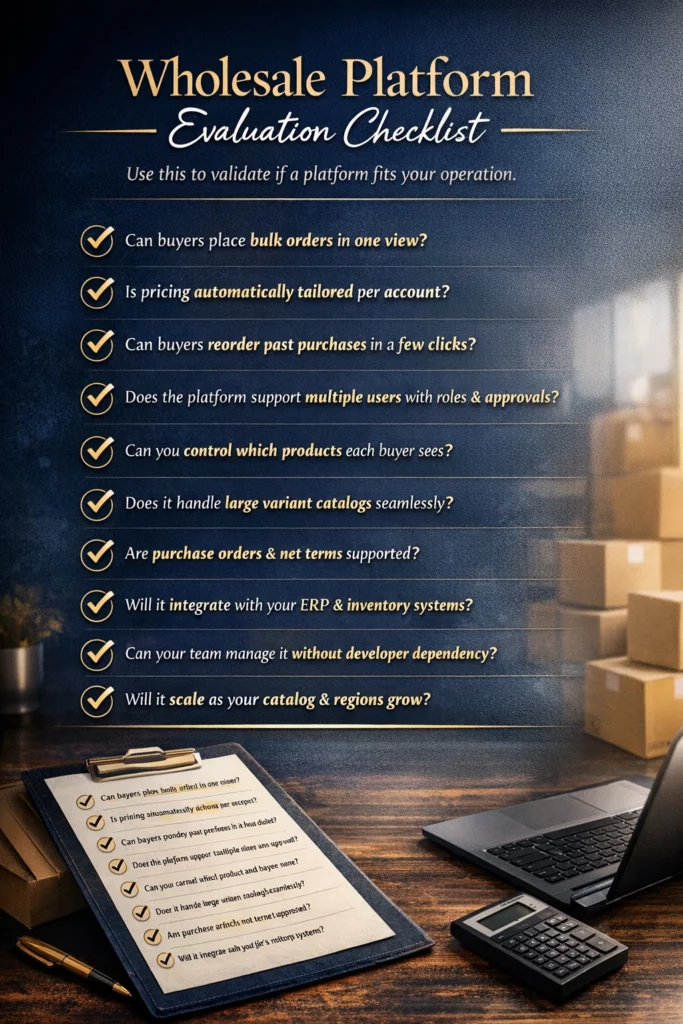
A fashion wholesale buyer needs to log in, see their specific pricing, order by style with full size and color matrix on one screen, submit purchase orders, request net terms, and reorder from previous seasons without rebuilding their cart. If a platform cannot support that workflow cleanly, buyers call your sales rep instead of ordering online. Your digital wholesale channel becomes a reference catalog, not a revenue channel.
Every criterion in this comparison is evaluated against that buyer workflow, not a generic B2B checklist.
B2B Buyer Portal and Account Management
The portal experience is what wholesale buyers interact with daily. How well each platform separates the B2B buying experience from a standard storefront matters.
Shopify Plus
B2B on Shopify creates a dedicated wholesale channel with company accounts, customer-specific price lists, and draft order capability. Buyers get a clean, separate login experience. It works well and deploys faster than the other two options.
The limitation is that some wholesale-specific behaviors still depend on apps or custom logic. For brands already on Shopify Plus for D2C, adding wholesale without migrating is a real operational advantage.
BigCommerce B2B Edition
Account management sits closer to the platform core. Customer groups, company accounts, and role-based access are configured natively without relying on apps. For distributors managing dozens of retailer accounts with different access rules, that native structure reduces ongoing maintenance.
Quote management and buyer-specific catalog visibility are more predictable here than on Shopify Plus.
Adobe Commerce
The most configurable buyer portal of the three. Company accounts, shared catalogs, requisition lists, and quick order by SKU are all native features. For enterprise manufacturers managing hundreds of wholesale accounts across multiple regions, that configurability matters.
The tradeoff is build time and ongoing development cost.
Variant Depth and Size/Color Matrix Ordering
Fashion SKUs are attribute-heavy. A single style in five colors and six sizes generates 30 variants. How each platform handles that at wholesale scale is a real differentiator.
Shopify Plus
Shopify’s native variant limit caps at 100 per product. For apparel brands with deep size-color-fit matrixes, that creates a problem. Workarounds exist through apps and custom development, but they add cost and complexity. This is one of the most commonly underestimated limitations for fashion businesses evaluating Shopify Plus.
BigCommerce B2B Edition
Handles higher variant counts more gracefully natively. Attribute-heavy fashion products sit more cleanly in BigCommerce’s catalog architecture. For mid-market wholesalers with wide style ranges, this removes a layer of custom engineering.
Adobe Commerce
The strongest native variant handling of the three. Complex configurable products, deep attribute sets, and multi-dimensional size-color-fit structures are well-supported. For manufacturers with hundreds of styles across multiple seasonal collections, this catalog depth is significant.
Customer-Specific Pricing and Payment Terms
Wholesale pricing in fashion is almost never one-size-fits-all. Different retailer accounts have different price tiers, order minimums, discount structures, and payment terms.
Shopify Plus
Customer-specific price lists work well for most scenarios. Net payment terms and purchase order workflows require apps or custom builds. For brands with straightforward tier structures, that is manageable. For more complex payment logic, the app dependency adds risk.
BigCommerce B2B Edition
Tiered pricing, customer-group-based pricing, and net terms support sit near the platform core. Purchase order workflows are available without building on third-party apps. For distributors managing many account types with distinct commercial arrangements, this reduces the custom development scope considerably.
Adobe Commerce
The deepest native pricing configurability of the three. Negotiated price quotes, contract pricing, multi-tier discount structures, and purchase order workflows are all platform-native. For enterprise operations where pricing logic is genuinely complex, this is where Adobe Commerce earns its place.
Seasonal Catalog and Lookbook Management
Fashion wholesale runs on seasons. Managing pre-season ordering windows, collection-specific catalog access by account, and lookbook-driven ordering is a workflow that generic eCommerce platforms handle poorly.
Shopify Plus
Seasonal catalog segmentation works through collections, customer-specific storefronts, and app-based tools. For brands with clean seasonal structures and moderate catalog complexity, this is workable. For manufacturers managing multiple collections across multiple buyer tiers simultaneously, it requires more custom configuration.
BigCommerce B2B Edition
Customer-group-based catalog visibility handles seasonal segmentation better natively. Different buyer groups can see different collections, pricing, and availability without heavy custom logic. A useful capability for distributors running pre-season and in-season ordering windows in parallel.
Adobe Commerce
Shared catalog functionality in Adobe Commerce allows granular control over which products, categories, and pricing are visible to which company accounts. For manufacturers managing multiple seasonal collections, brand lines, or regional wholesale channels, this is the most capable option natively.
ERP and PIM Integration
A fashion wholesale operation without clean ERP integration is running on manual data entry somewhere in the chain. Inventory accuracy, order sync, and pricing updates all depend on it.
Shopify Plus
ERP integration is well-supported through middleware platforms and direct API connectors. For most NetSuite or Dynamics integrations, reliable connectors exist. Where complexity increases, middleware adds cost.
BigCommerce B2B Edition
The open API architecture makes ERP and PIM integration more predictable at scale. For manufacturers running a fashion PIM to manage seasonal lookbooks and style attributes alongside an ERP for inventory and order management, BigCommerce’s API-first design keeps those integrations clean.
Adobe Commerce
The strongest integration depth of the three for complex, multi-warehouse ERP scenarios. For enterprise manufacturers with SAP or similar systems requiring deep two-way data flow, Adobe Commerce’s architecture supports that reliably.
CommerceShop handles eCommerce ERP integrations for fashion manufacturers across NetSuite, SAP, Infor, and others on all three platforms.
Headless Commerce for Fashion Brands
Headless commerce comes up often in fashion wholesale discussions, particularly for brands that want a custom buyer portal experience that does not look or feel like an off-the-shelf storefront.
The honest answer is that headless is not the right choice for every fashion wholesale build. It adds build time, cost, and ongoing front-end maintenance. But for manufacturers who need a custom dealer or retailer portal that is distinctly separate from their D2C experience, it is the right architecture.
Shopify Plus
Hydrogen and the Storefront API provide a mature headless path. Well-documented, well-supported, and an active developer community around it. A strong option for brands with development resources.
BigCommerce B2B Edition
The most API-flexible of the three. For fully custom wholesale portal builds where the front-end experience needs to be entirely bespoke, BigCommerce’s open API architecture gives the most freedom without platform constraints.
Adobe Commerce
Supports headless builds with PWA Studio and third-party front-end frameworks. More complex to implement than the other two, but appropriate for enterprise operations with the resources to support it.
Replatforming: What Fashion Manufacturers Need to Know
Replatforming a wholesale operation is not just a technical migration. For fashion businesses, it means preserving seasonal catalog structures, retailer account data, pricing tier configurations, and historical order data that buyers reference regularly.
Losing or corrupting that data has direct commercial consequences. Disrupting active wholesale accounts mid-season has even more.
A fashion manufacturer replatforming from a legacy system needs to plan for catalog data mapping, account migration with pricing rules intact, URL structure and SEO preservation, and a phased rollout that protects active accounts. Rushing any of those steps is where migrations go wrong.
If a DTC platform switch also affects your wholesale channel, scope the two separately. The requirements are different enough that conflating them into a single migration creates compromises that serve neither buyer group well. CommerceShop’s eCommerce migration services are structured to keep those tracks distinct throughout the project.
How to Choose the Right Platform for Your Fashion Wholesale Operation
Choosing the right platform comes down to how well it fits your wholesale workflow.
- Shopify Plus works best if you are D2C-led and adding wholesale with a simpler catalog and pricing setup.
- BigCommerce B2B Edition fits mid-market wholesalers managing multiple accounts and pricing tiers with stronger native B2B features.
- Adobe Commerce is suited for complex wholesale operations with deep variants, advanced pricing, and heavy ERP needs.
How CommerceShop Builds Fashion Wholesale eCommerce
CommerceShop is a certified partner for Shopify Plus, BigCommerce, and Adobe Commerce, with active experience building wholesale portals, seasonal catalog architecture, buyer account configuration, ERP integration, and platform migrations for fashion manufacturers and apparel distributors.
The platform recommendation always starts with the buyer workflow, catalog complexity, and operational requirements. Not a preferred platform.
Final Thoughts
Shopify Plus, BigCommerce B2B Edition, and Adobe Commerce all support fashion wholesale. What separates them is how much of the B2B wholesale workflow each platform handles natively, and how well they manage fashion-specific complexity like variant depth, seasonal catalogs, and retailer account logic. The right platform follows your wholesale operation’s actual requirements.
If your current platform is limiting how your wholesale buyers order, that is the problem worth solving first.
Trying to figure out which platform fits your wholesale operation before committing to a build or migration? Book a call with CommerceShop’s team. We will review your catalog structure, buyer workflows, and current platform gaps and give you a clear recommendation.
FAQs: Fashion Wholesale eCommerce Platforms
What features improve wholesale order speed for apparel buyers?
Bulk ordering tools, quick add-to-cart by SKU, and saved order templates significantly reduce ordering time for repeat buyers.
How do fashion brands reduce dependency on sales reps for wholesale orders?
By enabling self-serve portals with clear pricing, inventory visibility, and easy reordering, buyers can place orders without manual assistance.
What role does a PIM system play in fashion wholesale eCommerce?
A PIM centralizes product data like attributes, images, and seasonal collections, ensuring consistency across catalogs and channels.
How do wholesale buyers typically reorder products?
Most rely on past order history or saved lists. Platforms that surface reorder options clearly tend to see higher repeat purchase rates.
Why do some wholesale portals fail to get buyer adoption?
Poor usability, unclear pricing, and complex ordering flows often push buyers back to offline ordering methods.


