

The Ultimate Guide to Digital Marketing for Manufacturers

In an era where digital marketing for manufacturing industry leaders is reshaping how businesses grow, it has become an essential tool for engaging customers, building brand visibility, and driving revenue.
Manufacturers have traditionally relied on face-to-face sales, trade shows, and word-of-mouth referrals. While these methods still hold value, today’s industrial buyers are increasingly turning to digital platforms to research products, make purchasing decisions, and connect with vendors.
This guide explores what digital marketing for manufacturing companies actually looks like in practice, offering actionable insights into how manufacturers can develop and implement strategies that drive real results.
Why Digital Marketing Is Now the Manufacturer’s Strongest Sales Tool
Your best prospects are researching your competitors right now, without picking up the phone.
The procurement manager shortlisting vendors for a $2M contract is not waiting for your next booth appearance. They are building a shortlist before your sales team knows they exist.
Close to 70% of the B2B purchasing journey happens before a buyer speaks to a salesperson.
For manufacturers, being invisible at that stage means:
- Losing accounts to competitors with a stronger digital presence
- Missing the shortlist before your sales team gets a chance
- Watching high-value repeat suppliers quietly move on
The manufacturers pulling ahead are not the ones with the biggest catalog or the lowest price. They are the ones whose digital marketing for manufacturing industry presence makes buying from them feel easy, credible, and worth repeating.
5 Key Digital Marketing Tactics for Manufacturers
Knowing you need digital marketing is one thing. Knowing exactly where to put your energy is another. Here are the tactics that move the needle for manufacturers

SEO: Rank Where Your Suppliers Actually Search
Product-level and application-specific keywords are where B2B ecommerce manufacturers win search. “ISO-certified aluminum extrusions for automotive OEMs” pulls in a procurement manager mid-evaluation, exactly the buyer worth ranking for.
Your ecommerce architecture carries equal weight. Product schema markup, clean faceted navigation, and indexed spec sheets put your store in front of qualified buyers. CAD and BIM files optimized for search become a direct line to engineers already spec-ing out their next order.
Content Marketing: Build Tools Suppliers Actually Use
Suppliers evaluating your products want to know three things: does it fit their application, does it integrate with their systems, and do the numbers make sense? ROI calculators, integration guides, and comparison spec sheets answer all three faster and more convincingly than anything else.
Application-specific landing pages and video walkthroughs of complex ordering workflows do double duty: they rank organically and convert suppliers who land on them. That is content with a measurable return.
PPC and Paid Media: Reach the Entire Buying Committee
A single B2B purchase touches procurement, engineering, and finance. Google Search captures high-intent spec-level queries. LinkedIn reaches each stakeholder by job title, seniority, and company size within the same account, simultaneously.
Retargeting deserves its own budget line. Suppliers who viewed a product page, abandoned a quote form, or downloaded a spec sheet are signaling exactly where they are in the buying cycle. Each behavior warrants a different message and a separate audience segment.
Social Media: Post What Suppliers Save
Posts explaining how to select the right material grade for a specific application, or how to read a compliance certificate, consistently outperform product announcements in B2B feeds. Practical content gets saved, shared, and referenced again.
Manufacturers co-creating content with procurement consultants or industry association leaders build supplier trust at a speed that paid media rarely matches.
Email Marketing: Map Flows to the Supplier Relationship
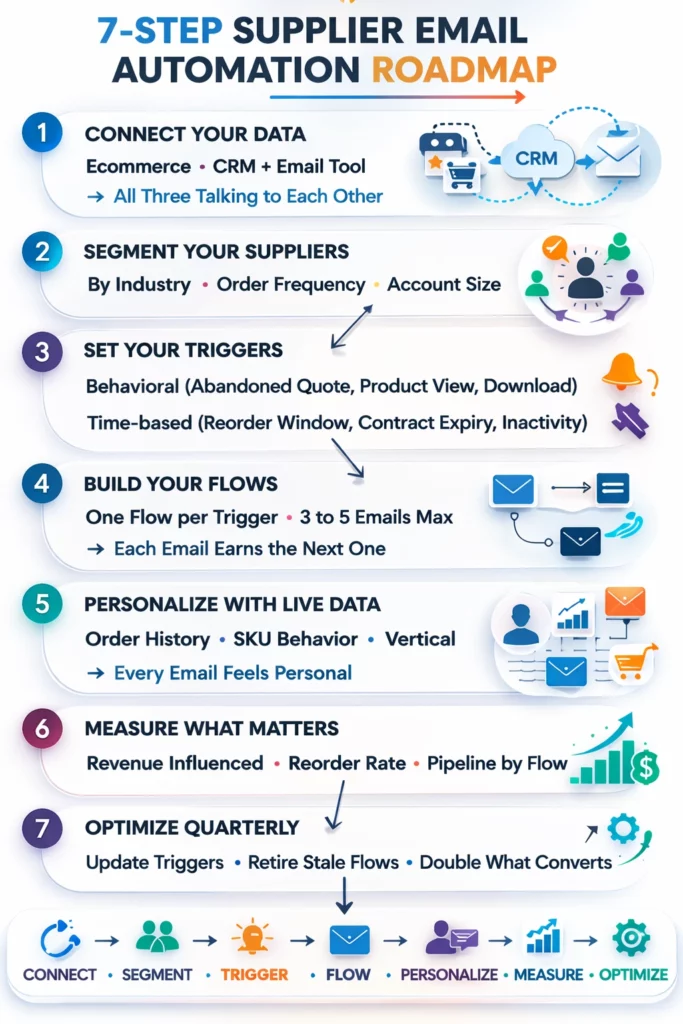
Five flows drive the most revenue for digital marketing for manufacturing companies: new supplier onboarding, reorder reminders tied to average purchase frequency, lapsed account win-back, new product announcements segmented by supplier vertical, and contract renewal sequences.
Dynamic content blocks pulling in product recommendations from a supplier’s actual order history make every email relevant to that specific account, handled automatically at scale.
Marketing Automation: Match the Tool to Your Operation
HubSpot fits small to mid-size manufacturers who want an all-in-one setup without a dedicated marketing ops team. Marketo suits larger teams running complex multi-channel programs. Pardot earns its place when your sales team lives inside Salesforce.
The right tool puts the right message in front of the right supplier at the right stage of their buying cycle, consistently and at scale.
How to Build a Digital Marketing Strategy for Manufacturers
Most manufacturers build their digital marketing strategy for manufacturing industry goals backwards. They pick channels first and figure out the audience later. The starting point is your supplier pipeline: how many active accounts you have, where they drop off, and which segment drives the most repeat revenue. Every strategic decision flows from that data.
Step 1: Map the Buying Committee
A single supplier account has three to five people involved in a purchase decision. The procurement manager shortlists vendors. The engineer validates specs. The CFO approves the budget. Your strategy needs a job to do for each of them, across every stage of the buying cycle.
Build a simple matrix: role across the top, buying stage down the side. Fill in what each person needs to see, hear, and trust before they move forward. That matrix becomes your content and channel brief.
Step 2: Separate Acquisition From Retention
These are two distinct strategies running in parallel, and most manufacturers treat them as one. Acquisition targets net-new supplier accounts through SEO, paid media, and ABM. Retention focuses on existing accounts through lifecycle email, portal personalization, and proactive reorder flows.
Your budget split between the two should reflect your actual revenue mix. If 70% of your revenue comes from repeat orders, your strategy should weight retention accordingly.
Step 3: Build a Channel Strategy Around the Buying Stage
Each channel serves a specific moment in the supplier journey.
| Buying Stage | Channel | What It Should Do |
| Awareness | SEO, LinkedIn | Surface your store for spec-level searches |
| Evaluation | PPC, Content | Answer technical questions, build credibility |
| Decision | Retargeting, Email | Remove friction, accelerate the quote |
| Post-purchase | Automation, Portal | Drive reorders, expand account value |
Spreading the budget evenly across channels is the fastest way to see results from none of them.
Step 4: Set Metrics That Connect to Revenue
Vanity metrics are easy to report and useless to act on. The numbers that actually tell you if your digital marketing strategy for the manufacturing industry program is working are supplier acquisition cost, time to first reorder, average order value growth per account, and marketing-influenced pipeline.
Set a baseline for each before a single campaign goes live. Every optimization decision from that point is made against those numbers.
Step 5: Build in a Quarterly Review Cadence
Markets shift, supplier behavior changes, and new competitors emerge. A strategy built in January needs a hard look in April. Review which channels are driving a qualified pipeline, which flows have the strongest reorder influence, and where supplier accounts are going quiet. Adjust budget and messaging accordingly.
The manufacturers who pull ahead are the ones who treat their strategy as a live document, not a slide deck that gets revisited once a year.
Overcoming Common Digital Marketing Challenges for Manufacturers
Most manufacturers do not struggle with digital marketing because it is complicated. They struggle because of how they approach it. Here is where things typically break down:
- Waiting for the perfect before publishing
Every week spent revising a campaign is a week a competitor is running one. A B+ campaign that launches beats an A+ campaign sitting in drafts. Ship, measure, improve.
- One person doing everything
A single coordinator cannot run SEO, manage paid media, write content, and report on results without something falling through. Pick the two channels with the highest return and resource those properly first.
- Treating the store and marketing as separate
Your ecommerce store generates behavioral data every day. Which products get viewed but not ordered? Where suppliers drop off. Which accounts have gone quiet? That data should be driving your marketing decisions, not sitting unused in your platform.
- Measuring vanity metrics
Page views and follower counts are easy to report and hard to act on. Supplier acquisition cost, reorder rate, and marketing-influenced pipeline are the numbers that actually tell you what is working.
- Outsourcing without giving context
Agencies produce generic work when they are treated like vendors. The manufacturers who get the best results from agencies are the ones who give them direct access to real customer conversations, product knowledge, and sales data.
Final Thoughts
The manufacturers winning supplier accounts right now are not the ones with the biggest budgets. They are the ones who show up consistently at every stage of the buyer journey, before the RFQ lands, before the shortlist is built, and long after the first order ships.
Digital marketing for B2B ecommerce manufacturers is not a department function. It is the system that keeps your pipeline full, your supplier accounts active, and your revenue compounding quarter over quarter.
Ready to Build a Digital Marketing Engine for Your Manufacturing Business?
We work specifically with B2B ecommerce manufacturers to build strategies that attract the right supplier accounts and keep them buying.
Get a Free Strategy Consultation
Ready to Take the Next Step? Explore These Guides:
Building Tomorrow’s Manufacturing Workforce: AI, Robotics & the Skills That Matter Now
The Ultimate Guide to Choosing a Manufacturing Web Design Agency in 2026
Reducing Manual Chaos: How Intelligent Automation Is Reshaping Manufacturing Ops
Why Most AI Initiatives Fail in Manufacturing and How to Build Ones That Scale
FAQs: Digital Marketing for Manufacturers
Our sales team already manages supplier relationships. Why do we need digital marketing on top of that?
Your sales team manages relationships with accounts they already know about. Digital marketing handles the 80% of the buyer journey that happens before a supplier ever contacts you. Without it, you are only visible to buyers who already know your name, and invisible to everyone else, shortlisting vendors right now.
We have a long sales cycle with multiple decision makers. Can digital marketing actually influence that?
This is exactly where digital marketing earns its place. Account-based marketing, retargeting, and segmented content let you reach the procurement manager, the engineer, and the finance lead simultaneously with messaging built for each role. You are not waiting for one person to make a decision. You are building consensus across the buying committee before your sales team even gets on a call.
How do we measure ROI on digital marketing when our sales cycles run 6 to 12 months?
Set leading indicators early: supplier acquisition cost, marketing-influenced pipeline, time to first reorder, and quote form completions. These give you signals within the first 90 days without waiting for a closed deal to prove the program is working. Closed revenue attribution comes later once your CRM and marketing platform are properly connected.
We already have an ecommerce store. Is that enough of a digital presence?
A store that buyers cannot find through search, that does not have spec-level content, and that has no post-purchase automation is a digital presence in name only. The store is the foundation. Digital marketing is what drives qualified suppliers to it, converts them on arrival, and keeps them coming back.
When is the right time to hire an agency versus building an internal team?
If you need to move fast and do not have 12 months to hire, onboard, and build an internal team from scratch, an agency gets you there faster. The strongest setup is an internal point person who knows your business, paired with an agency that knows digital marketing. That combination outperforms either option on its own.
We tried digital marketing before and saw no results. What was likely the problem?
In most cases, one of three things: tactics were chosen before a strategy was set, the program was not given enough time to compound, or the wrong metrics were used to evaluate success. Digital marketing for manufacturers is not a campaign. It is a system that takes over 12 to 18 months to build. Programs that get cut in month three rarely get a fair chance to show what they can do.
#digitalmarketingformanufacturers #b2becommerce #manufacturingmarketing #industrialmarketing #b2bdigitalmarketing


