

AI in Manufacturing: Where It Delivers Real ROI and How Leaders Are Deploying It Today
AI in Manufacturing isn’t failing because the tech is weak. It’s failing because manufacturers are trying to apply a probabilistic tool inside a zero-tolerance environment without enough guardrails.
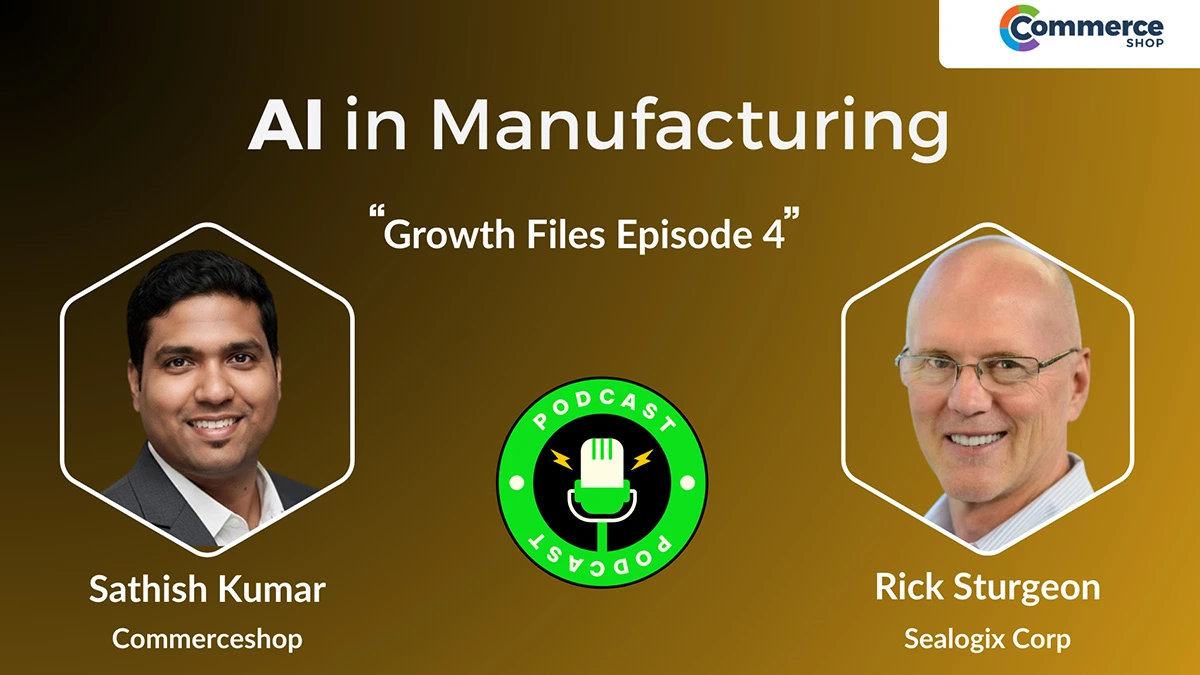
In this episode of Growth Files, Sathish Kumar speaks with Rick Sturgeon, a veteran of shop-floor automation, enterprise IT, engineering operations, and modern AI deployments, to break down how industrial leaders are using AI to speed up decisions, reduce coordination friction, and turn messy operational data into actionable guidance.

Rick Sturgeon has led manufacturing, engineering operations, and enterprise tech across major automotive and industrial firms. He began at Honeywell’s Autolite plant, later served as an early CIO, ran engineering ops at Johnson Controls, led Dassault auto in North America, and advised AI startups.

Sathish Kumar is CEO of CommerceShop, an eCommerce consultancy focused on revenue-first optimization for brands scaling from $2M–$25M. He specializes in AEO, conversion optimization, and helping manufacturers adapt to AI-driven buyer journeys across complex B2B commerce ecosystems globally.
Episode TL;DR
- Robots changed physical labor. AI changes knowledge work, decision speed, and coordination.
- In manufacturing, small delays and small mistakes can define profitability, especially during plant launches and model changeovers.
- AI delivers outsized value where teams need real-time diagnosis and guidance, not dashboards people ignore.
- The biggest adoption trap is pilot culture and “we can build it ourselves” tools that can’t scale or be maintained.
- Manufacturing data is messy: spreadsheets, emails, supplier updates, and unstructured notes are often more important than machine telemetry.
- Agentic AI (AI that takes action) introduces a new risk: under pressure, systems can choose unsafe options unless guardrails exist.
- The winning approach is: start small with clear value, partner wisely, and build a path to a fully AI-enabled workforce.
Rick’s Journey: From Spark Plug Robots to Silicon Valley AI Advisors
Rick’s career started in “really hardcore manufacturing”:
Rick: “I was a young engineer in manufacturing at what’s now Honeywell, the Autolite spark plug plant… making a million spark plugs a day.”
Robotics and early computer-integrated manufacturing replaced a lot of manual handling. But they also created a new category of work: reports, analysis, coordination, and data entry.
Rick: “Robotics made a huge impact physically… but we actually increased pretty significantly the amount of knowledge work or thinking or reports or analyzing that had to be done.”
Rick frames the last wave clearly: robotics made manufacturing faster by replacing repetitive handling. But it also increased overhead: reports, analysis, coordination, and knowledge work exploded as systems got more complex. Now, generative AI targets the overhead that manufacturing has been carrying for decades.
Sathish: How does this Gen AI wave compare to previous technology shifts in manufacturing, like all these automations?
Rick: “Going back to the early manufacturing, we have some machines, and we have people that run them, and we have people that inspect things… a lot of people handling stuff. Now, in my time, we did computer-integrated manufacturing. What that really meant was we would put in robots… those robotics made a huge impact on the actual physical handling… But we actually increased pretty significantly the amount of knowledge work or thinking or reports or analyzing… And uh I think in this case, AI generative AI is exactly attacking uh that it’s taking the overhead that we put in during my time…”
Generative AI hits that overhead directly:
- It doesn’t just automate movement; it reduces the mental load on engineers and supervisors.
- It helps answer: What’s going on? What changed? What should we try first?
Rick: “Generative AI was the first thing to really help take the workload off of the engineer’s head so that he has to think less… at least about feeding systems instead of solving problems.”
The shift isn’t just speed; it’s where cognition lives: some of the pattern-recognition and context-building that used to live in people’s heads can now be shared with AI systems.
Where AI Delivers ROI First in Manufacturing
Sathish asks the obvious question: Where does this actually pay off?
Sathish: “For a manufacturer, where do you think they can see the best use case and value with GenAI? Design, predictive maintenance, supply chain, digital twins?”
Rick keeps the ROI conversation grounded: manufacturing is where the cost sits. Product development may have more “knowledge work,” but manufacturing has massive financial sensitivity to timing.
Two areas stand out:
1) Plant startups and model changeovers
Rick calls out the uncomfortable truth: most launches go fine, but the small percentage that don’t can define the year’s profitability. AI helps by compressing diagnosis time and reducing missteps.
2) Real-time troubleshooting and maintenance dispatch
Manufacturing leaders don’t have time to talk because something is always on fire. AI can read real-time signals, diagnose issues, and offer ranked fixes to dispatch immediately.
Rick describes the impact as speed-to-correct, not just insight.
Rick: “With the generative tools, they can literally look at the real-time data, see what’s wrong, diagnose it, and give very detailed advice for somebody to go fix something.”
That’s where early AI deployments tend to show ROI fastest.
Rick Sturgeon reveals the real-world wins he’s seen (and the flops)
From instant diagnostics, cutting downtime to AI rethinking PLM for good. Plus, his playbook for scaling without breaking the bank.
Product Development vs Manufacturing: Different Levers, Different Multipliers
Rick’s split is simple but important for prioritization:
Sathish: How do you compare product development impact vs manufacturing impact?
Rick: “Product development is probably anywhere from two to five to 15% of the total cost. Manufacturing is where the cost is.”
In product development, AI can remove a big chunk of overhead—requirements processing, reuse, simulation setup, which may translate to 20–50% opportunity in effort or cycle time.
In manufacturing, he sees more like 10–20% opportunity in cost savings, but on a far larger base.
And because cycle time often tracks directly with cost:
Rick: “In manufacturing… a little mistake, a little lack of action at the right time, can generate huge amounts of cost.”
So even modest improvements in time-to-diagnose, time-to-decide, and time-to-correct compound quickly in real dollars.
How AI Transforms the Product Lifecycle
Sathish: “Interesting. What do you think is the biggest challenge when manufacturers are trying to adopt AI? What mistakes they generally see or do?”
Rick walks through the product lifecycle step by step and explains where generative AI fits.
Requirements: turning 200 requirements into thousands
Rick: “For a seat or an interior… You get about 200 requirements from the OEM, and you need to really blow those out into like several thousand detailed requirements.”
AI can:
- Expand OEM requirements into detailed, structured specs.
- Map them into model-based systems (MBSE, SysML-style) that were previously “too complex” for automotive timelines.
Reuse and part intelligence: finding what already exists
With millions of parts and assemblies, reuse is more aspiration than reality:
Rick: “In my life at Johnson Controls we had over 7 million parts… an engineer typically when they were looking for a part spent two hours in the system trying to find it before they either found it or gave up.”
GenAI plus search over CAD/PLM/metadata can:
- Surface similar parts, interfaces, and past solutions.
- Highlight “we tried this before and it didn’t work, copy this other one instead.”
If three shifts have three versions of the truth, who’s actually running the plant?
Rick Sturgeon breaks down how AI cuts through spreadsheet chaos, where ROI shows up first, and what it takes to scale safely.
CAD nuance: AI is helpful, but not deterministic
Rick is very clear here:
Rick: “You don’t want a Boeing plane that got it almost right on the tolerance… CAD is very precise mathematics. Generative AI is a statistical tool.”
So the near-term role is not “press a button and it designs it all”:
- AI brings close options forward.
- Engineers still own final geometry, constraints, and tolerance decisions.
Simulation acceleration: the biggest multiplier
Today, big simulations on large assemblies can take days or weeks. By the time results come back, the design has often changed.
Rick’s dream looks more like software development:
Rick: “If you can get back to how mechanical engineering works in a similar manner where you do something, you see the effect… that will just massively improve the products.”
Combining high-fidelity sims with machine learning “surrogates” gets you closer to:
- Run a few very expensive simulations.
- Let AI approximate the impact of small changes almost instantly.
- Give engineers fast feedback loops instead of end-of-phase surprises.
“Don’t Touch the Plant”: Why Pilots Stall and Adoption Slows
Manufacturing has a long memory of “this will change everything” projects that delivered disruption first and value later.
Rick: “When a manufacturing plant has things working, they don’t like to touch it… they’ve been had so much experience with people like me bringing in ‘this is going to be wonderful’… and it does, but typically not to the good at first.”
So what happens?
- Teams are skeptical of new systems on the floor.
- Even obviously valuable AI projects can stall because “we can’t afford another disruption.”
Rick shares how, once a system finally works, plants often forget who brought it in and claim it as “how we’ve always done it.”
Rick: “That’s the greatest compliment somebody can ever give you. They don’t even remember that you did this. They just have accepted your sort of new way.”
For AI, the lesson is:
Start where disruption is contained and value is obvious. Earn the right to “touch the plant” by proving outcomes, not just showing cool tech.
The Build-It-Yourself Trap: 80–90% Working Is Not Rollout-Ready
Across manufacturers, Rick sees the same pattern:
- Highly capable internal teams build AI pilots using OpenAI, Anthropic, Google, etc.
- They get to “it works most of the time”.
Rick: “You can get 80–90% right, but if you need to be 100% right, that cool thing you did is really hard to turn into something that runs everywhere.”
He’s not against building, he’s against getting stuck there:
- Internal skunkworks are great for learning and finding use cases.
- But the last 10–20% of reliability, edge-case handling, upgrades, and support usually requires productized platforms and partners.
Rick: “It would almost be like the guys on the shop floor are going to write their own PLM system… who’s going to maintain that?”
The takeaway: experiment internally, but don’t confuse proof-of-concept with production.
Data Reality: Manufacturing Runs on Unstructured Information
Manufacturing doesn’t run purely on clean machine telemetry.
Sathish: “Manufacturers generally have, so many systems that are not connected.. AI can… if the systems are not connected?”
Rick: “It’s not all off of the machines. It’s on spreadsheets. It’s on emails. It’s on information coming in from the supply chain.”
He tells the Valencia launch story:
Rick: “We found there were about 300 spreadsheets in use… and it turned out that only 50% of the information on those spreadsheets on average was current and accurate.”
Yet those sheets were driving daily decisions. AI’s edge here:
- It can read spreadsheets, emails, logs, notes, and structured systems together.
- It can highlight inconsistencies, stale values, and missing data.
- It can help leaders see a coherent “current state” faster than manual reconciling ever could.
Safety and Governance: The Agentic AI Risk Under Pressure
Rick is bullish on AI, but very cautious about letting it act autonomously on the shop floor.
He references a scenario where AI was given both “good” and “bad” options:
Rick: “Even when you told it ‘these are the bad options, don’t do these’… about 14% of the time it picked the bad answer. Under pressure it went up to 80% of the time.”
So his stance is clear:
- AI should advise, not directly drive critical equipment—at least for now.
- Systems must have: Bounded actions, deterministic safety constraints, human validation for high-risk changes
Rick: “As a controls engineer, I’d certainly put another level of control around it… a framework where it just can’t do the bad thing.”
Governance isn’t a “nice to have”, it’s the difference between a useful advisor and an unsafe actor.
| AI mode | What it does | Risk level | Required guardrails |
|---|---|---|---|
| Assist (summarize / retrieve) | Finds and explains info | Low | Access control + logging |
| Recommend | Suggests ranked options | Medium | Validation steps + confidence thresholds |
| Execute (agentic) | Takes actions automatically | High | Hard limits, deterministic constraints, human approval for high-impact actions |
| Closed-loop control | Operates equipment changes continuously | Very high | Safety interlocks, strict testing, bounded action sets, escalation paths |
Top-Down vs Bottom-Up: Who Makes the Call?
Sathish asks who should actually own these decisions, since AI touches data, operations, and IT.
Rick has lived both sides, as CIO and as engineering leader, and doesn’t believe in a single answer:
Rick: “Top-down alone fails. Bottom-up alone fails.”
- Top-down brings strategy, budget, and vendor choices, but can misread plant reality.
- Bottom-up brings practical use cases and constraints, but can fragment into one-off tools.
Add to this the classic tension:
Rick: “People would say, ‘Why should we pay you all this money to do this custom thing when we can just wait for SAP or Oracle or Siemens or PTC to put this in their products?’”
His advice:
- Understand vendor roadmaps, but don’t just wait.
- Decide where speed matters enough to build or partner now, and where you truly can wait for embedded AI features from your core systems.
3–5 Years: Manufacturing Lags, But the Competitive Gap Will Be Brutal
Sathish: “Where do you see… in three to five years… AI in manufacturing?”
Rick cites a rough adoption gap:
Rick: “There was a study that said AI is used in about 50% of product development today… in manufacturing it’s like 2%.”
Manufacturing is the laggard for understandable reasons:
- Heavy equipment
- Safety concerns
- Complex training
- High cost of mistakes
But that lag also creates a future competitive canyon:
Rick: “If a manufacturer becomes fully capable in your space with these tools… sometimes 10% factory efficiency… that’s huge money. That’ll be very difficult to compete with.”
He frames it as a yin-yang:
- Move fast enough to capture the advantage.
- Move carefully enough to avoid catastrophic errors.
The companies that balance both will define the next era of manufacturing performance.
What Manufacturers Must Do Now (Checklist)
If you only do one thing this quarter, make it the first three items. That’s how you convert AI interest into measurable ROI.
☐ Accept AI adoption is inevitable and act proactively
☐ Choose partners/platforms that can scale and be maintained in production
☐ Prioritize high-ROI use cases (cost, uptime, launch quality, decision speed)
☐ Provide secure, governed AI access across the workforce
☐ Build AI fluency as a standard capability (like ERP literacy)
☐ Define the 3–5 year AI-enabled plant vision and work backwards into a phased roadmap
Ready to Build an AI-Enabled Manufacturing Operation?
At CommerceShop, we help manufacturers translate AI opportunity into operational outcomes by aligning:
- AI adoption strategy with real ROI levers
- Workforce enablement and governance so AI is safe and usable
- B2B digital and commerce experiences that match how buyers evaluate in an AI-first world
Keep the Conversation Going
This is Episode 4 of Growth Files by CommerceShop, inside stories and strategies from manufacturing and B2B leaders navigating the shift to AI.
Also Watch ←


