

AEO & GEO in B2B Manufacturing: AI Answer Engines Impact on the Buyer Journey (Growth Files Ep. 1)
A potential customer just asked ChatGPT which circuit breaker manufacturers handle high-density data center installations. Your brand wasn’t mentioned. Neither was your distributor. Your competitor was cited three times with links to their spec sheets, case studies, and a distributor’s comparison guide.
This is happening right now across industrial equipment, automation systems, electrical components, and every other B2B manufacturing category. AI answer engines are becoming the first stop in buyer research, and they’re making shortlist decisions before prospects ever visit your website.
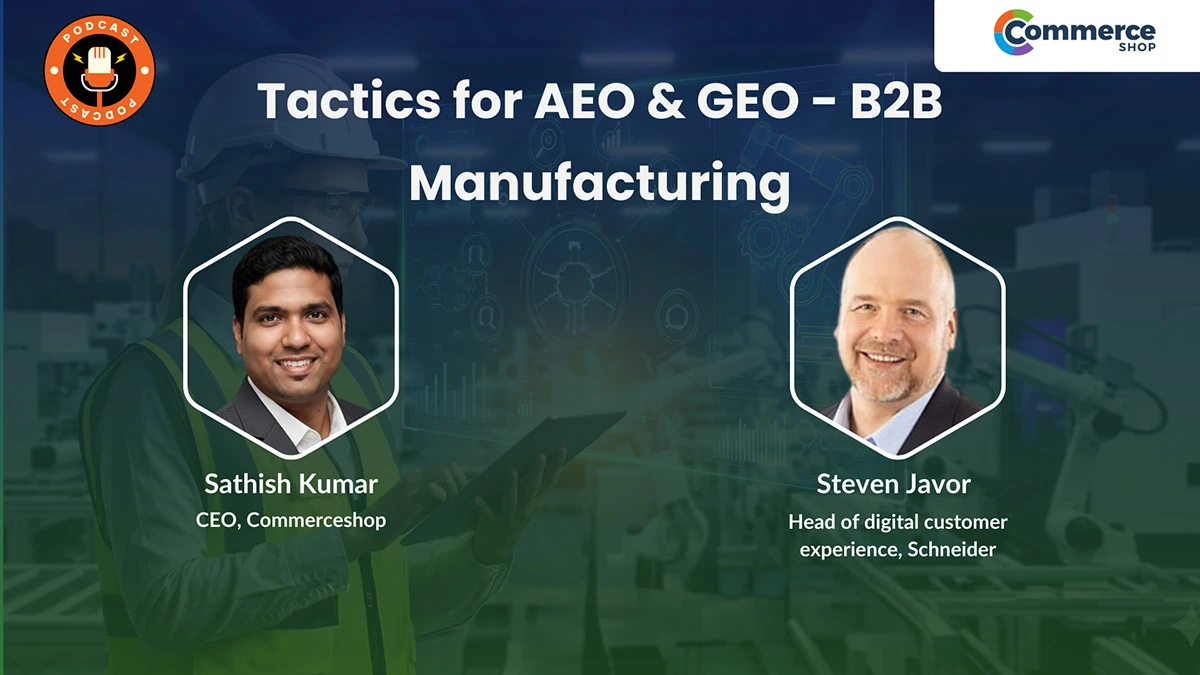
In this episode of Growth Files, we sit down with Steven Javor, who leads digital strategy at Schneider Electric, a $36B global manufacturer. Steven’s team ran 650 prompts across their top 12 product families to understand exactly how AI answer engines perceive, evaluate, and recommend manufacturers. What they discovered changes how B2B brands must approach content, channels, and customer experience.
Episode TL;DR
- Steven Javor’s team tested 650 prompts across 12 product families and found AI gets buyers 60% toward a decision before human contact
- 80% of citations come from outside your website (distributors, forums, YouTube, reviews)
- Three factors drive visibility: AI-readable content, structured Q&A formats, and third-party source influence
- Answer engines prefer human-written, up-to-date content that directly answers real questions
- The main challenge is change management across marketing, sales, and channel teams
In this conversation:
- Why AI answer engines get B2B buyers 60% of the way to a decision before human contact
- How prompt-based testing reveals where you win and lose in AI recommendations
- Why 80% of citations come from third-party sources you don’t control
- The three execution areas that determine visibility inside answer engines
- What manufacturers must change across marketing, sales, and distributor relationships
About the Guests:

Steven Javor leads digital strategy at Schneider Electric, overseeing AI integration, eCommerce platforms, and customer experience across a $36B global manufacturing organization. He has driven digital transformation since 1995, spanning eCommerce, social, mobile, and now AI-influenced buying behavior.

Sathish Kumar is CEO of CommerceShop, an eCommerce consultancy focused on revenue-first optimization for brands scaling from $2M–$25M. He specializes in AEO, conversion optimization, and helping manufacturers adapt to AI-driven buyer journeys across complex B2B commerce ecosystems globally.
AEO & GEO in B2B Manufacturing
Sathish: You’ve been building digital strategies since the late ’90s, e-commerce, social media, and mobile optimization. How does AI compare to those shifts?
Steven: I built my first e-commerce site in 1998. I’ve lived through every major digital transition since then. This one is different.
Social media changed distribution channels. Mobile changed form factors. E-commerce changed transaction models. AI answer engines change something more fundamental: who decides what buyers see first.
In traditional search, you could optimize your way to page one. On social media, you could build an audience. With AI answer engines, the platform synthesizes information from across the internet and decides without user input which brands get cited, which get ignored, and which get recommended.
Sathish: What problem do these engines actually solve for B2B buyers?
Steven: Speed. B2B buying involves multiple stakeholders, long evaluation cycles, and complex technical requirements. AI answer engines dramatically compress the early research phase.
Our data shows these engines get buyers about 60 percent of the way to a purchase decision before they ever talk to a human, whether that’s a sales rep, a distributor, or technical support.
They’re not making the final decision. But they’re determining who makes the shortlist.
How AI Evaluates Manufacturers: The 650-Prompt Test
Sathish: Walk us through how you tested AI perception of Schneider Electric’s products.
Steven: We took our top 12 product families, things like circuit breakers, industrial automation, energy management systems, and built roughly 650 prompts that mirror real customer questions across the entire buyer journey.
These weren’t generic “what is X” queries. They were specific scenarios:
- Discovery stage: “What automation systems work best for pharmaceutical cleanroom environments?”
- Evaluation stage: “Compare Schneider Electric TeSys contactors vs. ABB contactors for motor control.”
- Technical validation: “What circuit breaker meets UL 508A requirements for a 480V three-phase system?”
- Post-purchase: “How do I troubleshoot a Modicon PLC communication error code 16#2104?”
Why do AI answer engines recommend some manufacturers and ignore others?
AEO and GEO are already shaping how B2B buyers discover manufacturers. This conversation breaks down practical AEO and GEO tactics for B2B manufacturing.
We ran every prompt through multiple answer engines, ChatGPT, Perplexity, Google’s AI Overviews, Bing Chat, and tracked:
- How often we were cited vs. competitors
- Where citations came from (our site, distributors, third parties)
- Whether we were recommended or just mentioned
- What content the engines pulled and how they synthesized it
Sathish: What did you learn that you couldn’t have learned from traditional web analytics?
Steven: Traditional analytics tell you what happened on your site. Prompt testing shows you what happens before people reach your site and whether they reach it at all.
We found product families where we thought we had a strong market position, but AI engines consistently cited competitors first. Sometimes the issue was that our messaging didn’t match how customers asked questions. Sometimes competitors had better-structured content that engines could parse more easily.
And critically, we discovered that about 80 percent of citations came from sources outside our control, distributor sites, industry forums, review platforms, YouTube videos, and third-party spec databases.
Your brand website matters. But if you’re only optimizing your own domain, you’re missing 80% of the game.
Test Your Brand Visibility: Example Prompts to Run
Before we go further into strategy, you should see how AI answer engines currently perceive your brand. Here are specific prompts you can test right now in ChatGPT, Perplexity, or Google’s AI:
Discovery Stage Prompts
- “What [product category] manufacturers specialize in [specific application/industry]?”
Example: “What motor drive manufacturers specialize in food processing applications?” - “Best [product type] for [use case/constraint].”
Example: “Best programmable logic controllers for hazardous location environments”
Evaluation Stage Prompts
- “Compare [Your Brand] vs [Competitor] for [application]”
Example: “Compare Schneider Electric Altivar drives vs Siemens Sinamics drives for HVAC systems” - “What are the pros and cons of [Your Product Line]?”
Example: “What are the pros and cons of the Schneider Electric EcoStruxure platform?”
Technical Validation Prompts
- “[Specific technical requirement] + which manufacturers meet this?”
Example: “UL 508A Type 4X rated disconnect switches which manufacturers” - “What [product] handles [specific technical challenge]?”
Example: “What variable frequency drives handle regenerative braking in crane applications?”
Post-Purchase Support Prompts
- “How do I troubleshoot [specific product] [error/issue]?”
Example: “How do I troubleshoot Schneider Electric PowerLogic meter communication failure?”
What to look for when testing:
1. Are you cited at all?
2. If cited, are you recommended or just mentioned?
3. Where do the citations come from (your site, distributors, forums, reviews)?
4. How does your citation frequency compare to competitors?
5. Is the information accurate and current?
Run 10-15 prompts across your core product families. You’ll immediately see where you have visibility gaps and where competitors are winning.
The Three Pillars of AEO for B2B Manufacturers
Based on Schneider Electric’s testing and optimization work, here’s what determines whether AI answer engines surface your brand or ignore it.
Pillar 1: Your Owned Content Must Be AI-Readable
Steven: First, your website has to be accessible and understandable to Answer Engines. That sounds basic, but many B2B sites have structural problems that block AI entirely.
Common blocking issues:
- Gated content that requires registration before engines can access specs or documentation
- JavaScript-heavy experiences that don’t render for AI crawlers
- PDF-only technical documents without HTML alternatives
- Inconsistent product naming across pages (engines can’t connect “Model XR-2400” on one page with “XR2400 Series” on another)
What works:
- Structured Q&A content that directly answers customer questions
- Short, scannable sections with clear headings (engines prefer this over long paragraphs)
- Bullet points and tables for technical specifications
- Human-written content (not auto-generated from databases) that explains context, not just lists features
Think about how your product pages are written. Are they optimized for a human buyer reading carefully, or for an AI engine scanning quickly to extract key information? You need both.
Pillar 2: Answer Real Questions in Formats Engines Understand
Sathish: You mentioned human-written content. Does AI prefer content written by humans over AI-generated content?
Steven: Yes, and it’s somewhat ironic. The answer engines consistently favor content that is clearly written by humans who understand the subject matter, with natural language, real examples, and contextual explanations.
Auto-generated product descriptions from databases tend to be feature lists without explanation. Engines can parse them, but they don’t cite them as frequently as content that actually answers questions.
Content formats that perform well in AI citations:
FAQs that match real search intent:
- Not “What is a circuit breaker?” (too generic)
- But “What circuit breaker rating do I need for a 200-amp service panel?” (specific, actionable)
Comparison content:
- “When to use [Product A] vs. [Product B].”
- “How [Your Product] differs from [standard approach/competitor].”
Application guides:
- “How to select [product type] for [industry/use case].”
- “Best practices for [installation/configuration] in [specific environment]”
Troubleshooting content:
- “Common causes of [specific error/issue]”
- “How to diagnose [problem] in [product line].”
Engines pull from content that directly addresses intent. If your content forces buyers to infer answers, competitors with clearer explanations will get cited instead.
Pillar 3: Influence Third-Party Sources (The 80% Problem)
Sathish: Let’s dig into the 80% statistic. If most citations come from outside your domain, how do you influence that?
Steven: This is the hardest pillar and the one that most manufacturers underestimate. You have to think about Answer Engine Optimization the same way you’d think about PR or analyst relations; it’s about influence across an ecosystem, not just control of your own properties.
The third-party sources that matter most:
Distributor and partner websites:
If your products are sold through distribution, the sites need accurate, up-to-date, well-structured content. When a buyer asks, “Where can I buy [your product]?” the answer engine should list your distributors with accurate product information, not outdated specs or discontinued models.
We’ve found cases where distributors had old product literature on their sites, and engines cited that instead of our current specs. The buyer thinks they’re getting accurate information. They’re not.
Industry forums and communities:
Engineers and operators ask questions on forums such as Reddit, industry-specific communities, and LinkedIn groups. Those discussions get indexed and cited. If your brand isn’t part of those conversations or worse, if the conversations are negative and unaddressed, that affects recommendations.
Review and comparison sites:
Third-party review platforms, comparison tools, and spec aggregators often rank higher in AI citations than manufacturer sites because engines perceive them as more objective.
YouTube and video content:
Many answer engines now pull from video content for troubleshooting and how-to questions. If your competitors have installation videos, tutorials, and application guides on YouTube and you don’t, you’re invisible in those queries.
Technical documentation and standards sites:
For complex B2B products, engines cite compliance documentation, standards references, and technical white papers. If your products meet certain certifications or standards, that information needs to exist in formats engines can find and cite.
How to influence third-party sources:
1. Distributor content alignment: Provide distributors
with regularly updated, structured product data that they can easily integrate into their platforms. Make it easy for them to be accurate.2. Participate in communities: Your technical experts should be active in industry forums, answering questions and providing value (not selling). That builds citation equity.
3. Create shareable technical resources: White papers, application guides, and video tutorials that others will reference and link to.
4. Monitor and correct misinformation: Use tools to track where your products are mentioned online. When you find outdated or incorrect information, reach out to site owners to update it.
The goal isn’t to control its alignment. You want the entire ecosystem to say consistent, accurate things about your products, so answer engines scan and synthesize correct information regardless of source.

▶ Listen to the full episode on Spotify to understand how AI answer engines surface, rank, and recommend manufacturers.
What’s Changing: Traffic, Content, and Support
Sathish: How is AI already impacting website traffic and user behavior at Schneider Electric?
Steven: We’re seeing two simultaneous trends.
Overall traffic is softening slightly as answer engines resolve more queries without sending users to websites. Simple informational questions that used to drive traffic, “What is a soft starter?” or “How does a surge protector work?” are now answered directly in AI results.
But engagement quality is improving. The traffic we do get is more qualified. Users arrive deeper in the funnel because they’ve already done preliminary research through AI. They’re coming to our site for specific technical validation, to configure a solution, or to find a distributor, not to learn basics.
We’re also seeing shifts in which pages get traffic:
- Generic educational content is declining
- Deep product pages, technical specs, and application guides are growing
- Distributor locators and contact pages are growing
The implications: stop measuring success purely by traffic volume. A 10% traffic decline might actually indicate AI is pre-qualifying buyers more effectively. Focus on engagement depth, conversion rates, and revenue per visit.
Sathish: You mentioned a personal example with a Nespresso machine earlier. How does AI change post-purchase support?
Steven: My Nespresso machine had a flashing red light. Instead of calling support or digging through a manual, I took a photo, uploaded it to ChatGPT, and asked what it meant.
The engine pulled resources from multiple places, Nespresso’s site, YouTube repair videos, and forum discussions, and synthesized a clear answer. I fixed the issue in 10 minutes.
That’s the future of B2B technical support. Buyers will use AI to troubleshoot first. If your documentation isn’t structured for AI retrieval, competitors or third parties who have better content will be cited instead, even for your own products.
The question becomes: when a customer troubleshoots your product using AI, does the answer engine pull from your support content, or from someone else’s YouTube video?
Content Repurposing: Why Omnichannel Matters More Than Ever
Steven: Different answer engines go to different sources. Some pull heavily from YouTube. Others favor forums or Reddit. Some prioritize recent news articles and press releases.
You can’t assume that one content format will work for all engines. The same core information needs to exist in multiple formats across multiple platforms:
- Text content on your website (blog posts, FAQs, guides)
- Video content on YouTube (how-tos, troubleshooting, application demos)
- Structured data (schema markup, product specifications in machine-readable formats)
- Community presence (answering questions in forums, LinkedIn, Reddit)
- Downloadable resources (PDFs for white papers, but also HTML versions for better AI accessibility)
This isn’t about creating 5x more content. It’s about taking your core content, the product explanations, application guides, and technical answers that already exist, and formatting them for different platforms so answer engines can find and cite them wherever they look.
Internal Alignment: Marketing, Sales, and Distributors Must Speak the Same Language
Sathish: How does AI change the relationship between marketing, sales, and channel partners?
Steven: AI answer engines expose inconsistency immediately.
If marketing describes a product one way on the website, sales describes it differently in presentations, and distributors use entirely different terminology on their sites, the answer engine gets confused. It may not cite you at all because it can’t reconcile conflicting information.
What needs to align:
Product positioning and messaging:
Marketing, sales, and distributors should use the same language to describe products, applications, and benefits. That doesn’t mean identical word-for-word content, but it means consistent terminology and framing.
Technical specifications:
When distributors list your products, the specs should match your site exactly. Version numbers, certifications, dimensions, and ratings all must be current and consistent.
Pricing and availability:
If AI engines cite outdated pricing or discontinued products from distributor sites, that creates friction. Regular data sync between manufacturers and distributors becomes critical.
Support and troubleshooting information:
When a buyer asks an answer engine how to resolve a technical issue, the solution should be consistent whether the engine cites your support docs, a distributor’s FAQ, or a YouTube video.
This requires operational changes, not just marketing fixes. It means regular content audits across your ecosystem, distributor onboarding programs that include content standards, and sales enablement that reinforces consistent messaging.
The Change Management Challenge: Why Teams Resist AI
Sathish: What’s the biggest internal hurdle manufacturers face with AI adoption?
Steven: Change management. Specifically, fear.
People worry that AI will replace their jobs. Sales teams wonder if AI will eliminate the need for technical expertise. Support teams worry that AI troubleshooting will reduce demand for their services. Distributors worry that AI will disintermediate them by sending buyers directly to manufacturers.
The reality is different: AI replaces inefficiency, not expertise.
- Sales professionals who learn to use AI arrive at customer meetings better informed, with more relevant insights, and can address objections faster. They become more valuable, not less.
- Support teams that embrace AI can handle higher-complexity issues because AI resolves routine troubleshooting. They’re not doing less work; they’re doing higher-value work.
- Distributors who adapt their digital experiences for AI visibility don’t lose business; they gain it because they become the cited sources when buyers research options.
The teams that resist AI will fall behind. Not because AI replaces them, but because their competitors who use AI will outperform them.
The leadership challenge is helping teams see AI as augmentation, not replacement and showing them how to use it to strengthen their expertise, not bypass it.
Measurement: What KPIs Matter in an AI-Influenced World?
Sathish: Traditional metrics like organic traffic and keyword rankings don’t fully capture AI impact. What should manufacturers measure?
Steven: We’re adding new KPIs while reinterpreting existing ones.
New AI-specific metrics:
Citation frequency: How often do answer engines cite your brand when prompted with customer questions? Track this by product family and buyer journey stage.
Citation source mix: What percentage of citations come from your owned properties vs. distributors, vs. third parties? If 95% come from your site, you have limited third-party validation. If 5% come from your site, you’re not controlling your narrative.
Recommendation rate: Are you just mentioned, or are you actively recommended? There’s a big difference between “Schneider Electric also makes contactors” and “For pharmaceutical cleanroom applications, consider Schneider Electric’s TeSys line due to its IP69K rating.”
Accuracy score: When cited, is the information correct and current? Track instances of outdated specs, discontinued products, or incorrect pricing showing up in AI results.
Traditional metrics with new interpretation:
Website traffic: Declining traffic isn’t automatically bad. If engagement metrics (time on site, pages per session, conversion rate) improve while traffic declines slightly, AI may be pre-qualifying visitors more effectively.
Support ticket volume: If routine troubleshooting tickets decrease but complex issue escalations stay constant or increase, AI is working as intended, resolving simple problems and surfacing edge cases that need human expertise.
Sales cycle length: AI should compress early-stage research. If the time from first contact to qualified opportunity is shortening, AI is helping even if top-of-funnel traffic is down.
Distributor Relationships in an AI-First Ecosystem
Sathish: You’ve mentioned distributors several times. How critical are they to AI visibility?
Steven: Absolutely critical. For most B2B manufacturers, distributors are where buyers complete their evaluation and make purchases.
Answer engines often direct buyers to distributors for pricing, availability, and fulfillment. If distributor sites aren’t optimized for AI, you lose visibility at the most critical moment when buyers are ready to move from research to transaction.
What manufacturers must do:
Provide structured product data: Make it easy for distributors to integrate accurate, current product information into their platforms. Not just PDFs, structured data feeds that update automatically.
Monitor distributor content: Regularly audit what distributors are publishing about your products. Are specs current? Is messaging consistent? Are discontinued products still listed?
Enable distributor AI optimization: Help distributors optimize their sites for answer engines. Provide training, best practices, and content templates that make it easy for them to structure product information correctly.
Track distributor citations: When you test prompts, track which distributors get cited and which don’t. Double down on relationships with distributors who already rank well in AI results, and help others improve.
We only succeed if distributors succeed. In an AI-first world, that means helping them become credible, citable sources in answer engine results.
What B2B Manufacturers Must Do Now
AI answer engines are already influencing how buyers discover, evaluate, and shortlist manufacturers. This shift doesn’t replace human judgment B2B buying is still complex, relationship-driven, and expertise-dependent. But it does change where decisions begin and how quickly they move.
Manufacturers that adapt will stay visible. Those who don’t will be evaluated later, or not at all.
Here’s where to start:
1. Test your current visibility
Run 10-15 prompts across your core product families using the examples earlier in this post. Identify where you have citation gaps and where competitors win.
2. Audit your owned content for AI-readability
Can answer engines access and parse your product information, technical docs, and support content? Are there barriers (gated content, JavaScript walls, PDF-only resources) that block them?
3. Map your third-party ecosystem
List the distributors, partners, forums, review sites, and platforms where your products are mentioned. Audit accuracy and consistency. Prioritize the sources that answer engines cite most frequently.
4. Align your internal teams
Marketing, sales, support, and channel managers must use consistent terminology and messaging. AI engines expose inconsistency; immediately fix it before buyers notice.
5. Implement regular prompt-based testing
Don’t treat this as a one-time audit. Test quarterly or when launching new products. AI engines evolve, competitors adapt, and your visibility shifts. Stay ahead of it.
Ready to See Where AI Engines Cite Your Brand and Where They Don’t?
Most manufacturers don’t know how answer engines perceive their products until a competitor starts winning deals they should have closed.
We run prompt-based AEO testing across your product families to show you:
- Which answer engines cite you vs. competitors
- Where citations come from (your site, distributors, third parties)
- What blocks visibility across your content ecosystem
- Which high-impact pages to fix first for maximum citation lift
Get your AEO visibility snapshot
We’ll identify the top 10 revenue pages to optimize and show you exactly where you’re losing ground to competitors inside AI answers.
Keep the Conversation Going
This is Episode 1 of Growth Files by CommerceShop, inside stories and strategies from e-commerce and B2B leaders navigating the shift to AI-influenced buying.
Subscribe to Growth Files
Get insights from experts on how B2B buyers actually discover, evaluate, and decide in an AI-first world.


