

AEO for Manufacturers: How to Build Citation-Ready Spec Pages, Datasheets, and RFQ Content

Table of Contents
- Introduction: Why AEO Matters for Manufacturers
- What Manufacturers Need to Know About AEO
- Step 1: Building Citation-Ready Spec Pages
- Step 2: Optimizing Datasheets for AI Discovery
- Step 3: Refining RFQ Content for AI and Buyer Intent
- Step 4: Aligning with Distributor Ecosystems
- The Future of AEO in B2B Manufacturing
AI-driven answer engines are reshaping how B2B buyers discover and validate products. Engineers and procurement teams now rely on these systems to compare specifications, confirm compatibility, and build shortlists before engaging a supplier. Answer Engine Optimization (AEO) ensures your technical content is structured, authoritative, and machine-readable enough to be cited and recommended in those moments.
This requires more than traditional SEO. Spec pages, datasheets, and RFQ content must be engineered for both human buyers and AI systems. In this article, we outline how manufacturers can build citation-ready assets that win visibility in AI-powered discovery
What Manufacturers Need to Know About AEO
AEO is becoming increasingly critical as AI-driven engines gain influence over how products are discovered online. These engines differ from traditional search engines because they rely on understanding and interpreting queries and providing personalized answers. To ensure that your products are prominently featured, your content must be optimized to meet the standards that these AI engines prioritize.
These engines, powered by LLMs, don’t simply index content; they interpret queries, analyze vast amounts of information, and then provide personalized recommendations to users based on relevance and authority. AEO involves focusing on three core components:
- Citation Readiness: Ensuring that your content is easily cited by AI engines as a trusted and authoritative source.
- Relevance: Aligning content with the real-world queries and needs of B2B buyers and distributors.
- Technical Optimization: Structuring content in a way that AI engines can easily understand, including leveraging schema markup, structured data, and FAQs.
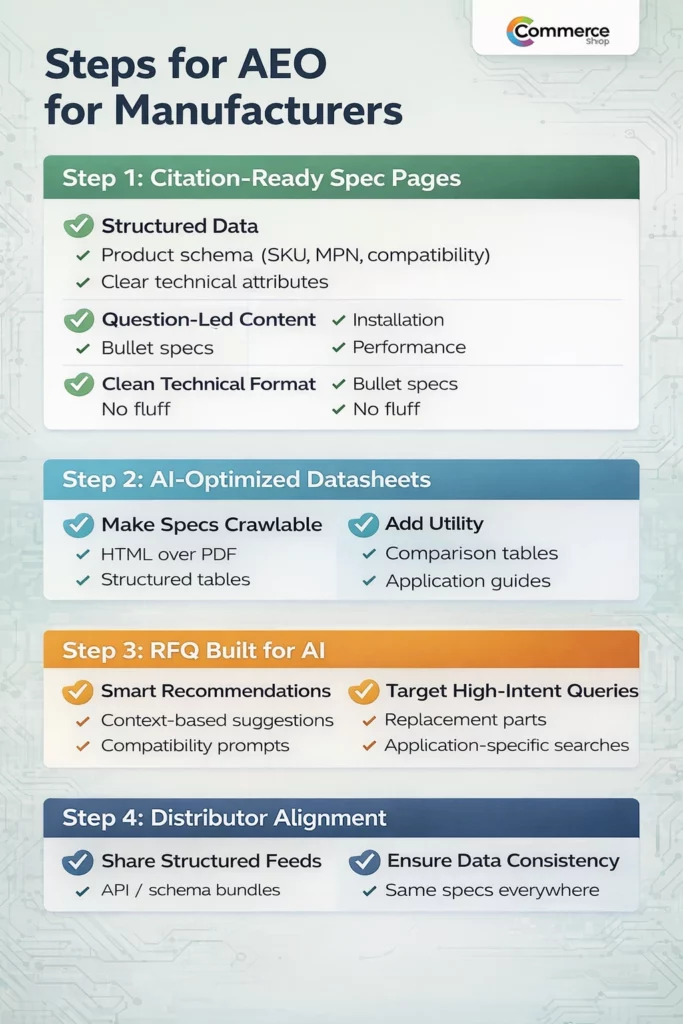
Step 1: Building Citation-Ready Spec Pages
Spec pages are the backbone of any B2B manufacturer’s product offering. These pages provide detailed technical information about products, dimensions, performance specifications, compliance certifications, etc. However, in an AI-driven world, these pages must go beyond basic product information. They must be citation-ready.
Key Strategies for Building Citation-Ready Spec Pages:
- Use Structured Data and Schema Markup: Schema markup helps AI engines understand the context and relationships of the content on your spec pages. By adding structured data (such as Product, Offer, and Review schema), you give AI engines explicit signals about what your content is and how it should be interpreted. This enhances your chances of being cited as an authoritative source.
- Answer Common Questions: Spec pages should directly address common questions about your products. For instance, including an FAQ section that addresses product performance, installation, or compatibility issues helps AI engines find relevant answers for users.
- Leverage Industry-Specific Keywords: AI engines interpret keyword relevance differently from traditional search engines. To ensure citation, manufacturers must identify and target keywords that their customers are actually using in the context of product selection, rather than generic terms.
- Create High-Quality, Human-Readable Content: While AI engines are becoming better at processing machine-generated content, human-generated content remains more authoritative. Ensuring your spec pages feature clear, concise, and technically sound descriptions will improve their credibility. Avoid overly technical jargon that may confuse both users and AI engines.

▶ Listen to the full episode on Spotify to understand how AI answer engines surface, rank, and recommend manufacturers.
Step 2: Optimizing Datasheets for AI Discovery
Datasheets are essential assets for B2B manufacturers, providing in-depth technical data about products. These sheets often serve as the primary reference for engineers and procurement officers.
Best Practices for Optimizing Datasheets for AI:
- Digitalize and Index Datasheets: If your datasheets are available only as downloadable PDFs, AI engines may have difficulty reading them. Consider converting key data points into HTML format or adding metadata to your PDF files to improve their readability. This enables AI engines to extract and index content more effectively.
- Integrate AI-Friendly Formats: Adding dynamic elements such as technical calculators, comparisons, or integration guides can make your datasheets more engaging and informative. These interactive elements not only help users make better decisions but also boost your visibility when AI engines are processing user queries related to technical requirements.
- Ensure Multi-Channel Accessibility: AI engines now pull data from various sources, including websites, PDFs, and even third-party sites like Reddit and Wikipedia. Ensure your datasheets are easily accessible through multiple platforms and link them across your content ecosystem.
Why do some manufacturers get cited in AI answers while others disappear?
AEO is redefining how manufacturers structure spec pages, datasheets, and RFQ content for AI visibility. In this episode, we break down how to build citation-ready technical assets that answer engines recommend.

Step 3: Refining RFQ Content for AI and Customer Interactions
RFQs (Request for Quotation) are vital in B2B manufacturing, often representing the point at which a prospect moves from casual interest to serious consideration. Optimizing RFQ content for AI discovery is essential for ensuring that manufacturers remain top of mind when distributors, partners, and end customers are making purchase decisions.
Steps to Optimize RFQ Content:
- Incorporate Product Recommendations: AI engines can now suggest specific products based on a buyer’s inquiry. By integrating AI-powered recommendation systems into your RFQ forms, manufacturers can preemptively offer relevant product options based on the customer’s past behavior or industry standards. This creates a more seamless experience for distributors and customers while providing valuable data for future marketing efforts.
- Leverage Contextual Data: The key to getting AI engines to cite your RFQ content lies in providing contextual data that aligns with how users search for products. Use smart tagging and dynamic content that adjusts based on customer profile, location, and industry. This allows AI engines to match the right content to the right customer at the right time.
- Optimize for B2B Long-Tail Search: Long-tail keywords related to RFQs are important for manufacturers to target, especially when buyers are searching for very specific product solutions. Ensure that your RFQ content targets niche queries and speaks directly to the pain points or challenges faced by your customers. This type of content is more likely to be cited by AI engines, which focus on relevance and specificity.
Step 4: Aligning with Distributor Ecosystems
Manufacturers and distributors share a symbiotic relationship in B2B ecosystems. To maximize AEO efforts, manufacturers must ensure that their content is properly indexed and cited across their distributor networks.
Key Considerations for Manufacturers:
- Share Knowledge and Data: Manufacturers should collaborate with their distributors to ensure that product information is easily accessible and correctly structured on both parties’ platforms. Sharing content through APIs and ensuring that distributors are also AEO-optimized will significantly boost visibility across the AI landscape.
- Leverage Partner Reviews and Testimonials: AI engines prioritize authoritative third-party content. Encouraging distributors to feature your products in reviews, comparisons, and roundups on trusted industry websites can help increase your content’s credibility and visibility.
- Work on Data Consistency: Ensure that your product information is consistent across all touchpoints, whether on your website, a distributor’s platform, or third-party comparison sites. Inconsistencies can confuse AI engines and hurt your chances of being cited as a trusted source.
The Future of AEO for Manufacturers
AEO represents a crucial shift in how manufacturers must approach their digital content strategies. As AI-powered engines continue to gain ground, it will become increasingly essential for manufacturers to optimize their spec pages, datasheets, and RFQ content to be citation-ready. By focusing on structured data, human-readable content, and AI-friendly formats, manufacturers can increase their chances of being discovered, recommended, and cited by AI engines.
By utilising AI technologies and aligning them with business processes, manufacturers can gain a competitive edge that will drive higher conversion rates, better customer experiences, and ultimately, greater business success.
Subscribe to Growth Files
Get insights from experts on how B2B buyers actually discover, evaluate, and decide in an AI-first world.


